Welcome to the Bentley Priory Nature Reserve nature trail. The trail was designed by the Harrow Nature Conservation Forum. Hardware and installation were funded by Harrow Council’s Green Grid project.
Bentley Priory Nature Reserve occupies much of the land originally created as parkland for Bentley Priory House, at the top of the hill. Deer Path follows the original driveway to the house, and the road name Old Lodge Way refers to the lodge guarding the entrance to the park. The Old Lodge still stands, at the corner of Old Lodge Way and the Uxbridge Road.
The total length of the trail is 2.9 km. The first part of the trail follows the metalled path, called Deer Path, but the second half can be extremely muddy, especially in autumn and winter. At these times waterproof boots are advisable.
If you are starting at the Old Lodge Way entrance, begin by following Deer Path up the hill through Old Lodge Meadow. In winter look out for groups of winter thrushes. Fieldfares are large thrushes with grey on the top of the head and the rump. Redwings are smaller with a prominent pale stripe above the eye.
Look out for the first numbered post, just before you enter the woodland.
If you are starting at Common Road, follow the metalled Weald Path until you reach post 9.
We hope you enjoy the trail. Please send any comments, photographs, and notes about interesting species seen to admin@harrowncf.org.
Post 1: In the small copse to the right of the path grow many of the trees and bushes that you will see again and again on your walk. The largest tree is a pendunculate or English oak, Quercus robor. The name pedunculate refers to the stalk, or peduncule, that connects the acorn cup to the twig. The pedunculate oak is the dominant oak in southern England while the sessile oak is most common in the north, although you will see one specimen on the trail today.
The other tree in this little copse is a hornbeam Carpinus betulus, one of the commonest trees in the reserve. Hornbeam wood is extremely hard and in the past was used for gear wheels, for example in clock mechanisms.
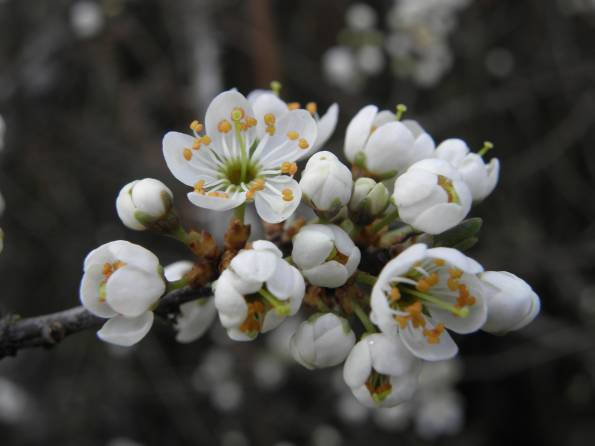
The little copse also contains bushes of blackthorn Prunus spinosa and hawthorn Crataegus monogyna. Both bear thorns, although those of blackthorn are longer and sharper. In early spring blackthorn, a relative of the plum, bears masses of white blossom on otherwise bare twigs (see illustration below). Later in the year blackthorn bears its fruit, called sloes. These are too bitter to eat but are used to flavour gin. Hawthorn flowers later, in April and May (indeed its other name is May). Dog rose Rosa canina clambers through the thorn bushes and flowers all too briefly in May and June.
Go through the gate into the wood.
Post 2: The woodland here is dominated by hornbeam, although you can also see sycamore and horse chestnut.
The first Marquis of Abercorn bought Bentley Priory in 1786. Sir Uvedale Price, his landscape gardener, designed much of the parkland that we see today. To the left of the path at this point is a raised causeway, like a miniature railway embankment. This raised path was created so that the marquis could ride around his park without going through any mud. On the causeway, close to the metalled path, you can see some trees with characteristic horizontal bands on the bark. These are the wild cherry or gean Prunus avium; the fruit are loved by foxes. In March and April look up into the crowns to make out the blossom.
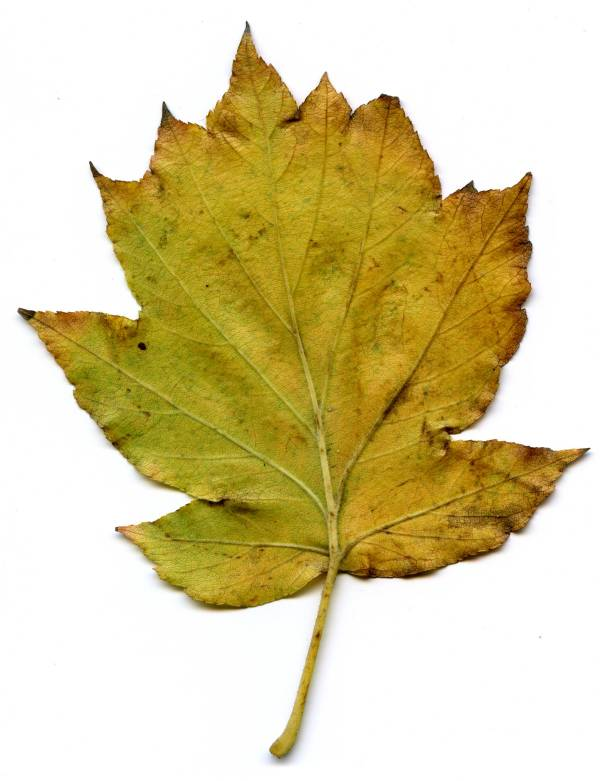
Post 3: The prominent tree with the V shaped double trunk is a wild service tree Sorbus torminalis. The leaves are a distinctive shape – see illustration below – as if the tree intended to have hand shaped leaves like a sycamore but stopped half way. The fruit is edible, although bitter, but is not much eaten today. Wild service trees, like hornbeam, are an indicator of ancient woodland, that is, land that has been wooded since 1600 and therefore probably never cleared by man.
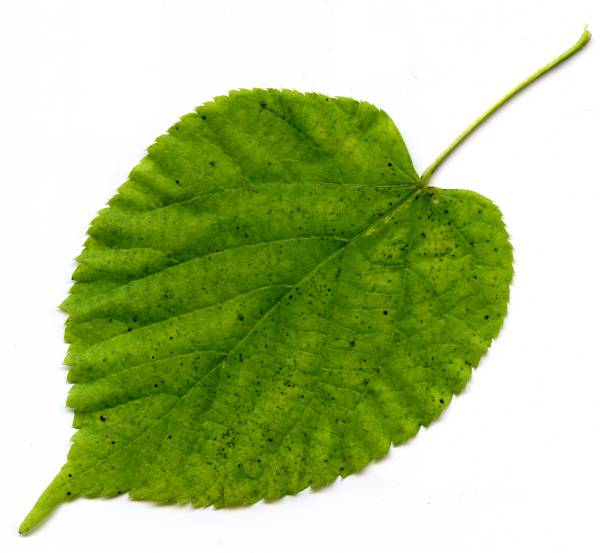
To the left of the wild service tree and closer to the path is a lime or linden tree. The leaves have a distinctive extended tip – see illustration below.
Immediately ahead the path crosses a little valley called the Dell. The stream flows in from the housing to the east and is sadly often polluted.
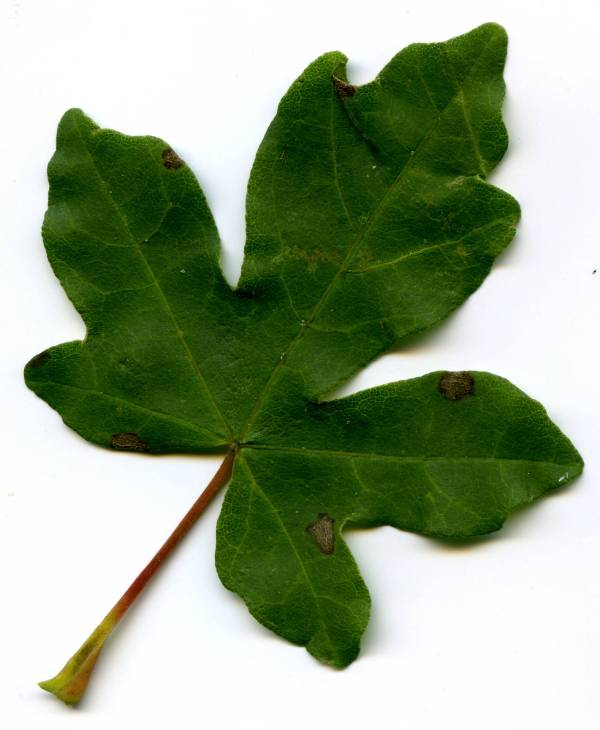
Post 4: Field maple, Acer campestre grows on both sides of the path. Field maple is a small tree or bush and, unlike its relative the sycamore, is a true English native. The leaves are very like those of sycamore, although much smaller – see illustration below. In spring look for a blooming crab apple on the left side of the path.
A few metres up ahead a square manhole can be seen to the left of the path and one can usually hear rushing water below. This is not a sewer, but a major drinking water supply to the London Ring Main.
Along this section of the path look out for coppiced hornbeams, mainly on the left side. A coppiced tree is cut down all the way to the base, and grows out a mass of new young branches to form a tight bush. Coppicing allows the growth of many more ground level plants than are found in mature woodland, while the tight bush-like coppice stands are perfect for nesting birds including blackbird, robin, wren, dunnock and blackcap.
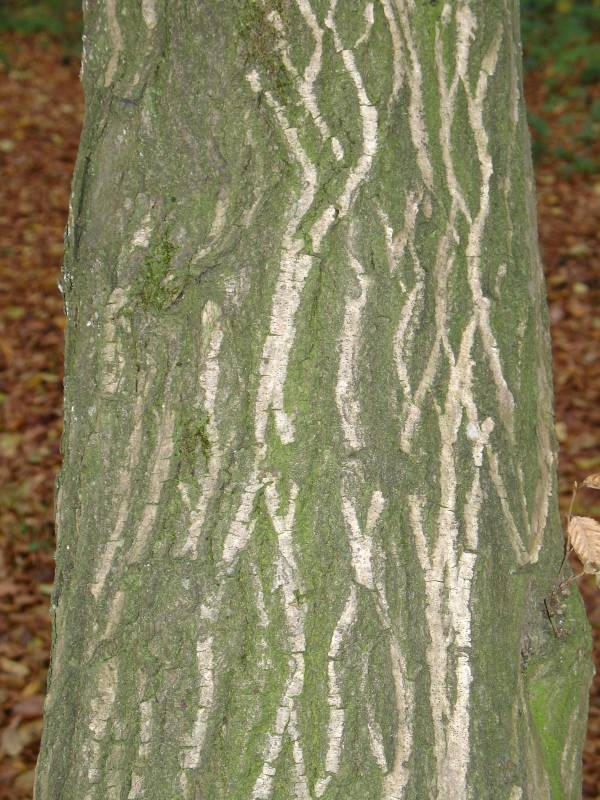
Post 5: You are now entering Heriots Wood, a larger expanse of ancient woodland dominated by hornbeam. Older hornbeam trees often develop an interesting pattern on their bark, ridges crossing and recrossing to form diamond patterns – see illustration below. See if you can find examples here or as you walk on up the path.
To the left a second number 5 marker post sits in a shallow ditch. This is a parish boundary and probably predates the Marquis of Abercorn. On our side of the ditch we are in Great Stanmore; Harrow Weald lies the on other side.
Post 6: The metal fence on the right encloses a private deer park with fallow deer. The deer are descendants of the herd introduced by the Marquis of Abercorn. They love to be fed carrots, apples and other vegetables – but please do not give them bread, which will make them ill.
On the left of the path a wooden fence encloses an area of mature hornbeam wood. Hornbeam produces a mass of winged seeds that form a carpet on the ground in autumn and are a welcome food source for migrating and overwintering finches, especially chaffinch and brambling. We have built the fence to keep out the cows and also to discourage dogs from running at the birds and scaring them. Visitors and dogs are not prevented from entering the area – a squeeze stile a little further up allows access.
The deer park is a favourite spot for the flock of up to fifty jackdaws that nest in the reserve. The “Jack” call of these small crows seems somehow friendlier than the harsh “Caw” of the carrion crow.
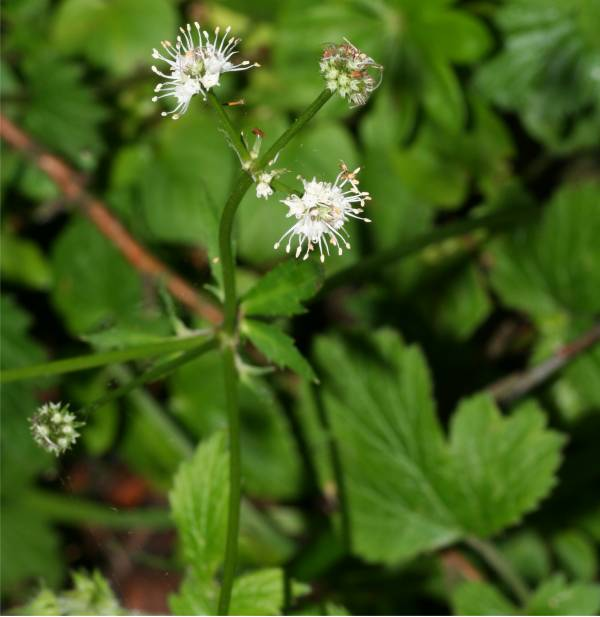
As you walk up the path, look out look along the left hand side of the path for sanicle Sanicula europaea, a member of the carrot family with palmate leaves rather like those of a sycamore tree. The white flowers (see illustration below) appear from May through August. The presence of sanicle is another sign that this is ancient woodland.
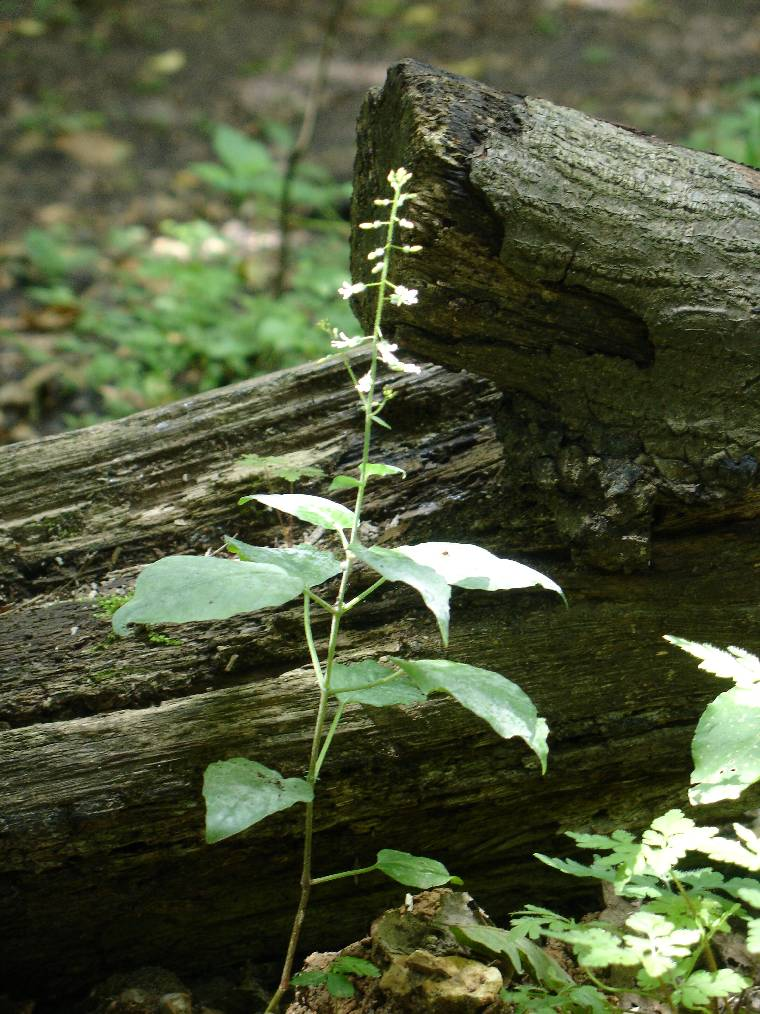
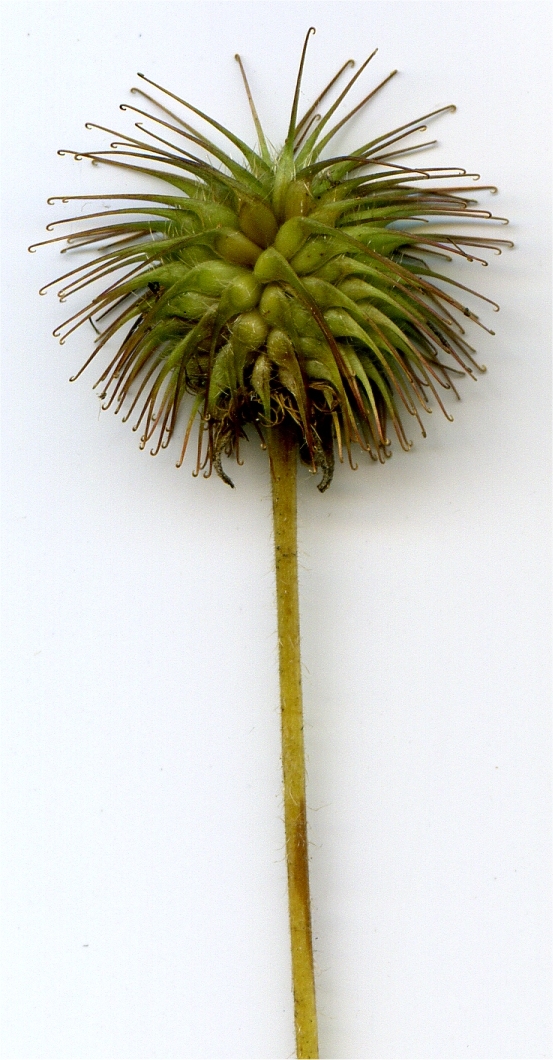
Post 7: Not many plants can grow in the dry, shady environment of the forest floor in high summer. Two that can, Enchanters Nightshade Circaea lutetiana and Wood Avens Geum urbanum, grow to the left of the path here. Enchanters Nightshade bears a spike of delicate little white flowers (see illustration below) while Wood Avens bears simple yellow flowers like a buttercup, and later characteristic balls of seeds each with a hook to catch onto the fur of passing animals (see illustration below).
Post 8: The majestic oak tree on the right of the path is a turkey oak Quercus cerris. The turkey oak is not an English native, and over much of the reserve it is removed as an invasive weed, however this fine specimen will be retained. The acorns are borne in a hairy cup like a bird’s nest.
The ruined building to the left of the path was built just before the second world war to house a telephone exchange. At that time Bentley Priory house had been bought by the RAF and was being fitted out as a command centre for the coming air war, so 300 new telephone lines were installed.
Post 9: The metal fence to the right is the boundary of what was the RAF land. Bentley Priory house lies within, but is difficult to see behind the screen of trees. On this side of the fence one can just make out a wide, flattened causeway leading 100 metres or so downhill. This is what remains of a gravel runway built for light aircraft during the Second World War.
The open land here is acid grassland, full of bright flowers in spring and summer. In early summer the meadow is full of the white umbels of pignut Conopodium majus, like a miniature cow parsely. Look out also for tormentil Potentilla erecta, a member of the rose family with masses of small yellow flowers. Unusually for the rose family, tormentil flowers have four, rather than five, petals. Another rose family member, agrimony Agrimonia eupatoria, sends up spikes of yellow flowers. Later in the year (July, August and September) look for the yellow daisy-like flowers of ragwort Senecio jacobaea, the blue pom-poms of devils-bit scabious Succisa pratensis (see illustration below) and harebell Campanula rotundifolia, the Scottish bluebell. Just ahead is a patch of gorse Ulex europaeus, another plant that likes acid, well-drained soils. It flowers all year round so whatever the season you should be able to find flowers somewhere on it.
The humps in the grass are nests of the yellow meadow ant Lasius flavus. These ants are the favourite food of the green woodpecker, the largest of the three woodpecker species found in the reserve. The other two woodpeckers, the greater and lesser spotted woodpeckers, stay within the wooded areas.
This is the best part of the reserve for butterflies. Butterflies that have been seen in Bentley Priory include small copper, gatekeeper, common blue, purple hairstreak, meadow brown, small skipper, small white, large white, orange tip, red admiral, painted lady, small tortoiseshell and speckled wood.
From here on a clear day we have a glorious view right across the London basin to Box Hill and Leith Hill, 50 km away (see illustration below). At this point you leave the metalled path and descend the grassy ride called The Greensward. The scrubby edges of The Greensward are a favourite for many birds, which can be difficult to spot among the branches: song and mistle thrushes, dunnock, wren, whitethroat, lesser whitethroat, blackcap and longtailed, blue and great tit.


Post 10: Flower-rich grassland is scarce in England. It is under threat from many sides: from development, from farming intensification or, as in Harrow’s nature reserves, from encroaching scrub and woodland. In 2012 the Bentley Priory Nature Reserve Management Committee was awarded a Heritage Lottery Fund grant to clear scrub that was invading the grassland, and this has paid for the clearance of the area to the right of this point. The seeds of the grassland plants lie dormant in the soil for many years. As soon as the scrub is cleared, they germinate and restore the lovely flower-rich meadowland.
Here the nature trail bears to the right and crosses the first of many wet spots then continues down The Greensward. If the ground just ahead is too boggy for your footwear, you should instead bear left at this point. The path will lead you back to Deer Path.
Post 11: As we descend The Greensward, the soil becomes less acid, and the composition of the grassland flora changes subtly. Look out for the blue flower spikes of bugle Ajuga reptans – see illustration below – and the tiny white flowers of lesser stitchwort Stellaria graminea. Lesser stitchwort, which flowers from May through August, has five petals, but each is so deeply divided that at first glance one would say that the flower has ten petals. Later in the year (June through September) look for birds foot trefoil Lotus corniculatus – see illustration below. The flowers are like those of peas and when fully open are bright yellow, but as they open the petals are tinged bright orange, giving the plant its alternative name of bacon and egg plant.
As you proceed beyond post 11, look out for the arrow post that directs you to the right and off The Greensward.


Post 12: This pine grove is one of three planted by Sir John Kelk, an eminent Victorian engineer who bought Bentley Priory house and the estate in 1863. The pine needles form a lovely soft carpet underfoot. From here, the nature trail runs straight ahead and descends towards Summerhouse Lake, which soon comes into sight in front of you.
Post 13: The shore of Summerhouse Lake lies just ahead. In summer it may still be obscured by trees so if you want to, go straight ahead on the narrow path to the water’s edge before returning to this point – but you will get plenty of views of the lake as the trail continues.
Look for a second number 13 marker post ahead and to the left. This marks a sweet chestnut tree Castanea sativa, probably another planting by Sir John Kelk. In a good year, trees in England produce nuts large enough to be worth harvesting and roasting, but in most years the nuts are best left for squirrels.
At this point you turn right and follow the path around the lake. In winter, listen for feeding flocks of siskin high in the trees, feeding on the seeds in pine and alder cones; goldfinches and occasional redpoll also visit.
In spring look out for woodland flowers including primroses Primula vulgaris, wood anemone Anemone nemorosa and the yellow buttercup-like flowers of lesser celandine Ranunculus ficaria – see illustration below. Ramsons or wild garlic Allium ursinum has pretty white flowers and is easily recognised by its garlic smell.

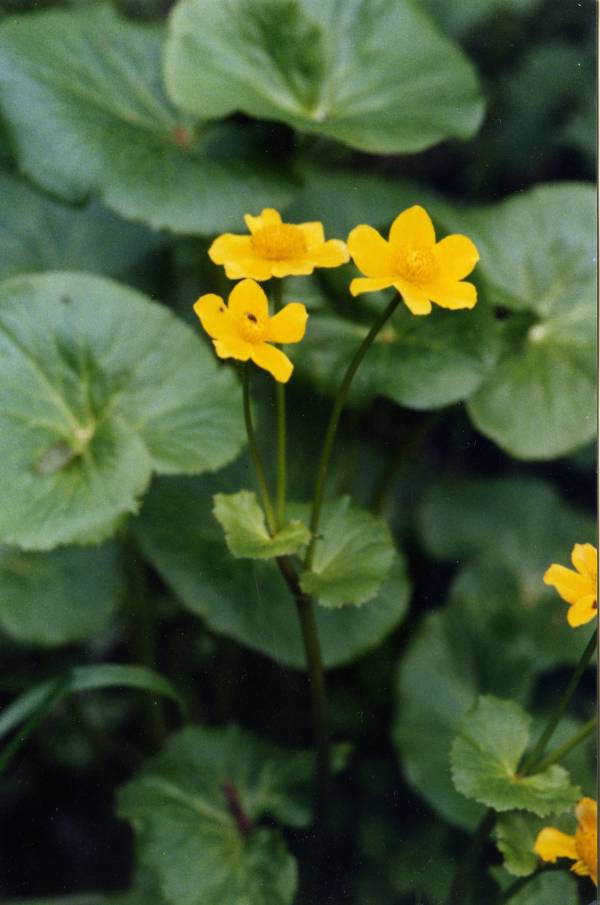
Post 14: The stream flows through a brickwork pit before entering the lake. This is a silt trap; every few years silt that would otherwise flow into the lake and gradually fill it up is dug out of the trap. To the left you can see a marshy area at the head of the lake. This is home to a number of wetland plants including marsh marigold or kingcup Caltha palustris, a member of the buttercup family with broad simple leaves – see illustration below. The bright yellow flowers appear in April through June.
Herons can often be seen here hunting for frogs. In winter, a lucky observer will see a kingfisher perched on a post or stump at the water’s edge. These lovely birds regularly overwinter around the lake but are wary and surprisingly difficult to spot.
Post 15: This short ride connects the open ground of Spring Meadow to the west with Summerhouse Lake. It is kept open to provide a flyway for bats. Bats flying above Bentley Priory or nesting in holes in old trees include Daubenton’s, noctule, pipistrelle, soprano pipistrelle and natterer’s.
Post 16: This mound and another ten metres to the south (with the arrow post on top) are all that remain of two ice houses. Before the invention of electric refrigerators, ice was cut from the lake and stored in the half-buried buildings. The ice would last well into the summer and could then be carried up to the house at the top of the hill as needed. In late April through May this area of the woodland is a carpet of bluebells.
Post 17: The tiny island to the left is called Scott Island, in honour of Sir Walter Scott. A small gazebo or summerhouse stood on the island in the 19th century, and it was here in the summer of 1807 that Scott wrote the epic poem Marmion. Scott made his name as a poet, but later became famous as a writer of popular novels including Rob Roy and Ivanhoe.
Post 18: To the right is the magnificent Master Oak. This is certainly 350 years old, and was therefore alive during Charles II’s reign; it may well be much older. From this point, bear left and follow the path beside the brick dam.
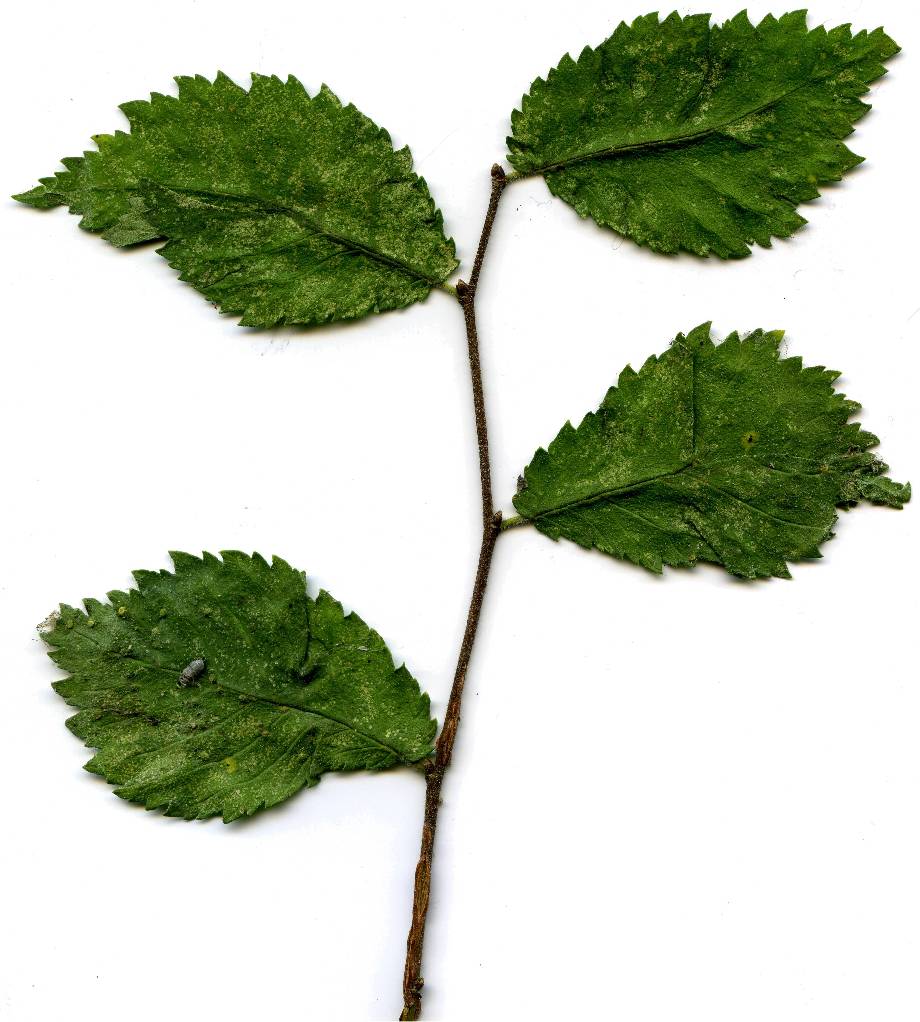
Post 19: You can now see that Summerhouse Lake is artificial, formed at the time of the Marquis of Abercorn by damming the valley of the Stanburn that falls away to the southeast. The lake and dam are maintained by the Environment Agency as a flood defence; at times of heavy rain, the lake can be allowed to fill up to the top of the dam then release the water slowly. The small tree by the post is an elm Ulmus procera. Elm leaves are often highly assymetic at the base (see illustration below). Dutch Elm Disease kills any plants that grow larger than these small trees here, but elm is still common as a woody shrub in this area of the reserve.
Coot, moorhen, mallard and mandarin duck breed on the lake in summer, along with Canada geese. Winter visitors include the small black and white tufted duck along with shoveler, goosander, pochard, gadwall, teal, dabchick and black headed gull.
From here, go over the stile and turn left along the track. Look out for Red Campion Silene dioica – there is a chance of seeing flowers all the way from March through October. The flowers have five petals, each deeply divided (see illustration below). Red Campion likes the richer clay soil in the south of the reserve.

Post 20: At this point one path bears right into Mase Field, but we keep straight on into Stanburn Wood. In spring this area of woodland is lovely with the white flowers of wood anemone, the yellow flowers of lesser celandine – see illustration below – and the blue dog violet.
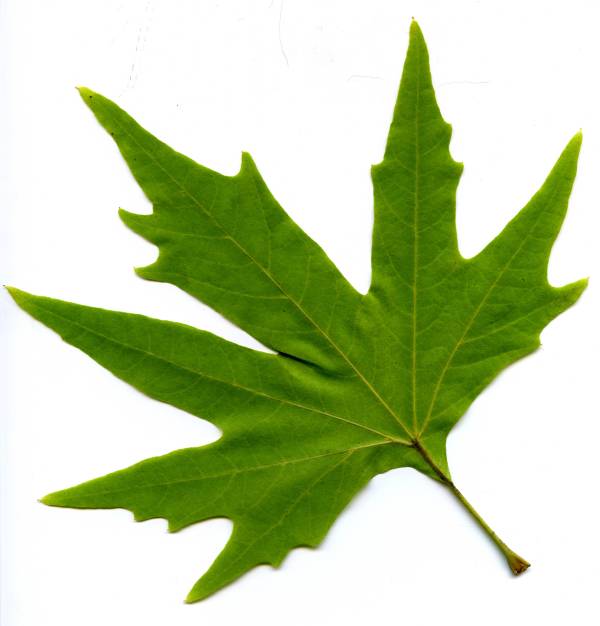
Post 21: Just ahead is a second number 21 marker post, but the ground between can be extremely boggy. The second post marks another of Sir John Kelk’s plantings: an oriental plane Platanus orientalis, native to southeastern Europe. It bears lovely large, deeply cut palmate leaves – see illustration below. A hybrid between this species and the American sycamore Platanus occidentalis generated the London plane which graces many streets in central London.
Bear right through the squeeze stile and then bear left at the arrow post.
Post 22 At this point the little stream that we saw at the Dell at the start of the trail joins the Stanburn. The tree in the angle between the two streams is an alder Alnus glutinosa. Alders love wet places, although they can tolerate dryer locations and are often planted as street trees. They bear characteristic dark fruits that resemble pine cones.
From here the trail crosses the Stanburn on the remains of a dam dating from the Marquis of Abercorn’s time. Keep to the centre to remove any danger of falling, and take care that small children do not slip.
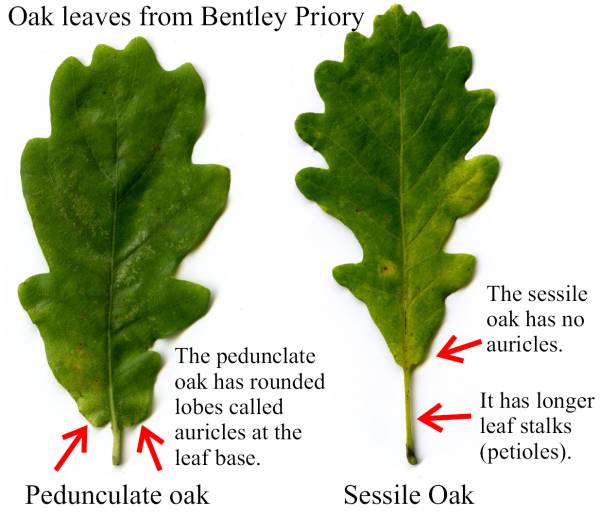
Post 23: The tree nearer the stream, with two boles, is a pendunculate oak, the species we have seen many of. However, the tree with three boles on the other side is a sessile oak Quercus petraea. This is named sessile because it bears its acorns closely apposed to the twig. The leaves of the two oak species are subtly different – see illustrations below.
From here there is a lovely view down the Stanburn with Hornbeam Wood, which is indeed all young hornbeam, to the left of the stream. From here head towards the squeeze stile in the fence then bear left via a gated boardwalk to re-enter Old Lodge Meadow.
Post 24: You are now back in Old Lodge Meadow. The herd of cows that graze Bentley Priory in the summer and autumn are often found here. Since cows graze unevenly, taking some clumps down to the ground and leaving others standing tall, the complexity of the grassland structure is increased resulting in improved biodiversity.
In April, May and June look for the violet-pink blooms of cuckoo flower Cardamine pratensis. Like all crucifers, the four flower petals are arranged in a simple symmetric cross. At the same time of year look for the orange-tip butterfly, whose caterpillars feed on cuckoo-flower. Males are unmistakable, with orange tips to their forewings, while females are all white.
Later in the year look for the purple flowers of common knapweed Centaurea nigra. Knapweed flowers are typical thistle-shaped, but unlike thistles the plant itself is not prickly – see illustration below.

Post 25: This is Boot Pond, so called because of its shape. As part of a large London-wide scheme to improve the environment for amphibians and reptiles, the Heritage Lottery Fund is funding a project to close off the “toe” of the pond to your right from the main volume of water. The hope is that this will keep fish out of the toe area and therefore allow amphibians, especially newts, to breed.
From here it is a short walk back to the Old Lodge Way gate and the end of the trail. We hope you have enjoyed it. Please send any comments, photographs, and notes about interesting species seen to admin@harrowncf.org.
If you started the trail in the middle, you can continue the trail by walking diagonally uphill to join the metalled path. You should be able to see post 1 on the path just before it enters the wood.