Post 1: Welcome to Stanmore Common. This place is a council owned nature reserve of around 122 acres of mixed woodland, wetland and grassland. The reserve is bisected by Warren Lane, the last unlit road in the borough. The majority of the reserve lies north of the road and this is the direction you are facing at the start of the trail.
Topographically the reserve is a shallow valley with the highest point on the corner of Warren Lane and the Common and the lowest point away to the northeast which lies to your front right. The trails will cross the grain of the valley so it will gently descend and ascend. The steepest slope is up from the lowest point back towards the car park.
The soil structure of the reserve is impermeable London clay topped by pebbles. This means that water is NOT free draining and lies near the surface. When it rains water discharges from springs and so the reserve is always damp and often very wet and muddy underfoot, especially in autumn and winter.
The reserve is very important because of its rare habitats and wildlife. It is rated a Site of Metropolitan Importance to Wildlife and is fully protected by law as a Local Nature Reserve.
Historically the site was part of a much larger open area, and was a Common a site owned by the people and used for grazing, shooting, gravel extraction and breeding rabbits. As you go around the trails you will see evidence of some of this human activity.
Both routes will take you through the main habitats and both will pass interesting features which one can see or hear at all or sometime in the year. The reserve is visited by Bats, Badgers, Deer and Foxes. There are Snakes, Mice, Voles, Frogs, Toads and much more. Its insect life is rich (the site is wet/damp and Mosquitos and biting midges are common) and there is a good range of plant species some are very uncommon.
Taking your time when you go around and being quiet at the stopping points maximises your chance of seeing and hearing the wildlife. If you see something nice do record it and send it to us at www.hncf.org.
Please respect the wildlife and do not collect wild flowers or fungi (You can go badly wrong with fungi if you do not know what you are doing). It is also important to collect all dog waste and dispose of it in bins or take it away with you. The delicate wild flowers that live the Common are crowded out by ranker plants wherever dog waste adds nutrients to the soil.
From here at post 1 you can follow the Long Trail (red arrows) or the Short trail (blue arrows). These meet in Bluebell Heath at the north of the Common from where a single Return Trail (orange arrows) brings you back here. Including the return leg, the Long Trail is 1.2 miles and the Short Trail is just under one mile long.
For the shorter trail head straight ahead down the open Witling Ride. Rides are very important places as within woodlands they are light filled areas which support a lot of wildlife who need the light and heat. Rides need to be kept open and this ride has had work done on it by the Trust for Conservation Volunteers a national charity who do voluntary conservation work all over the UK.
You will see 2 sets of picnic benches. The old set has been here for decades and they were replaced last year by the new ones. We kept some of the old ones as they have nice moss colonies on them.
Keep an eye out for short trail post 2 on the left hand side of the ride. It may be hidden by bracken.
Short trail post 2: From here you can see two mature oaks. You passed one a few yards back up the ride, and there is one a few yards further down the ride to your right. These two oaks grew while the land was open meadow and contrast with all the surrounding trees, which are much younger.
Framing the path ahead are three silver birches, about 50 years old, but all the younger trees about are oak and beech. As you follow the path into the woodland notice that almost all the fallen trees are birch. Birch is one of the first trees to colonize open ground, since it has tiny, fine seeds with twin outgrowths that act as sails that are blown far on the wind. However birch is short lived and cannot compete with the slower growing but sturdier oak and beech.

The common shrub layer plant under the trees is bramble whose fruit is the blackberry. Bramble is an important wildlife plant but it can be invasive in rarer habitats such as grassland and needs controlling.
As you walk through the wood you will see brash piles where our volunteer group has been felling trees to get more light into the woodland. The cut down material is left in piles for animals to use as winter shelter.
Descend to the bridge over Holly Brook and then continue to post 3.
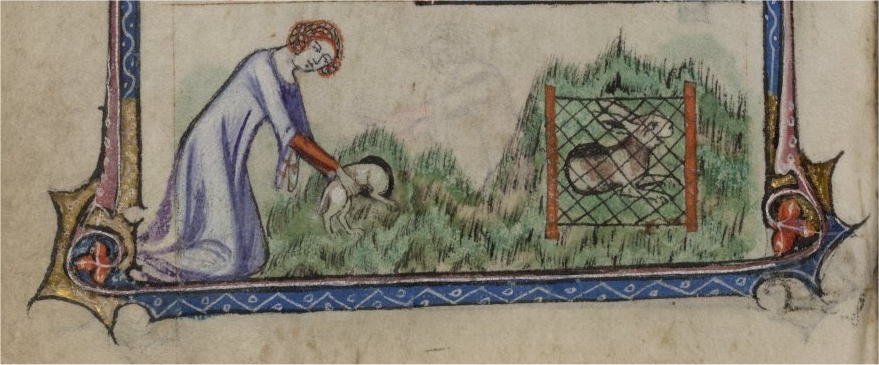
Short trail post 3: In front of you is Fox Earth mound, built as an artificial rabbit warren. Rabbits were brought to England by the Normans as a food source and kept in artificial hillocks surrounded by a fence. Rabbits are a Mediterranean species and had difficulty adapting to the harsh British winters. The rabbits were looked after by warreners. This is not the only man-made warren on the Common, but this is the best defined and the most accessible. Most warrens were long structures so this round form is unusual.
Short trail post 4: This open meadow is Cerrislande. The vegetation is a rich mix of grasses, bracken, scrub and wild flowers including the yellow creeping buttercup. The tall woody stems are willows. Identifying willow to species is difficult especially since the various species hybridise freely. The plants here have oval leaves with paler green below and an intricate vein network, suggesting goat willow Salix caprea, however grey willow Salix cinerea can look almost identical. Whatever they are, they need to be controlled: if volunteers did not cut the willow and other woody plants on rotation this area would rapidly revert to willow scrub then woodland.
There is a lot of bracken, a native fern of dryer soils. Bracken supports thirty species of invertebrates, so it is a valuable plant. However it does tend to be invasive, dominating the open ground and shading out grasses and flowers, so we do control it to maintain a mix of vegetation.
Short trail post 5: This large tree is a Turkey oak, Quercus cerris. It comes from Turkey, Greece, and the Balkans. It was introduced into the UK in the 1700’s. One can identify it by the deeply indented leaves and the hairs that surround its buds and acorn cups. It does not have as great a range of invertebrates as our two native oaks; pedunculate oak Quercus robor, the commonest native oak on the reserve, and sessile oak Quercus petraea which is only found in the far north west edge of Stanmore Common. We do weed out turkey oak saplings but we keep the magnificent large trees.
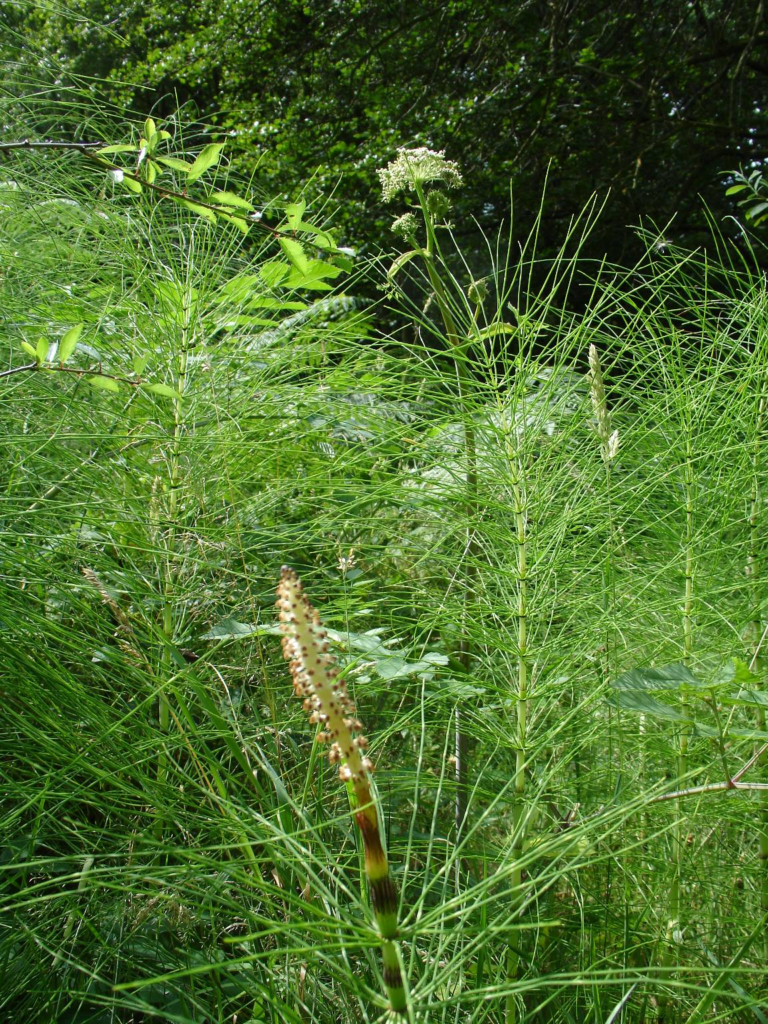
Turn right and follow the path downhill. In summer notice the green bottlebrushes of great horsetail Equisetum telmateia. Horsetails contain a lot of silica in their cell walls and this makes the stems very hard and tough. Horsetails used to be used as pot scourers and in burnishing silver.
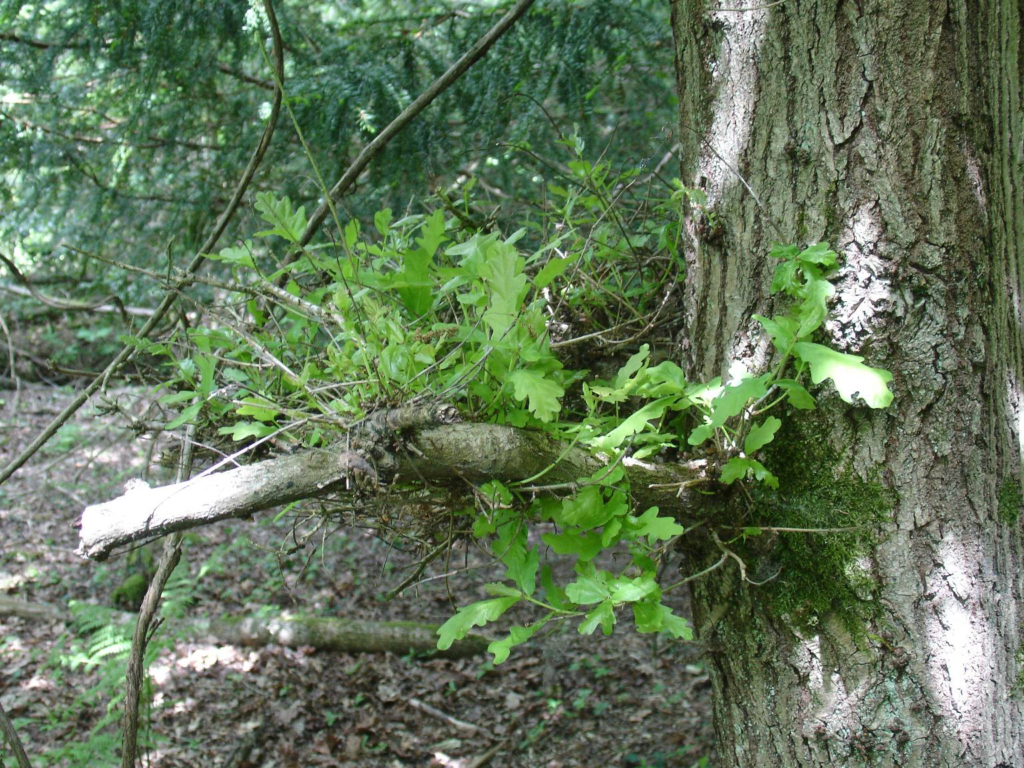
Short trail post 6: The young oak tree ahead and to the left has masses of small twigs growing out of the trunk and side branches producing shaggy clusters known as witches’ brooms. Witches’ brooms are formed by many species of trees in response to a wide variety of stress events; it might be a gall-forming insect or mite, aphids or bacterial/fungal colonisation or even mistletoe which sets it off.
Tykes Water lies a few steps ahead. This is the major stream of the reserve and in early spring is full of young stonefly larvae, an indicator of good water quality. The larvae are nevertheless hard to see because they hide under stones and amongst debris. The adults are poor fliers and stay close to the water.
After crossing Tykes Water look at the sycamore tree to the left of the path. It is covered by what looks like a tangle of rope. This is Honeysuckle, a climbing plant which grows over the woodland floor until it finds a tree to climb up. When it gets to light it flowers. The flowers give a powerful scent which moths love.
Honeysuckle is the food plant of the reserve’s rarest butterfly, the white admiral. The adult flies throughout June and July and into August.
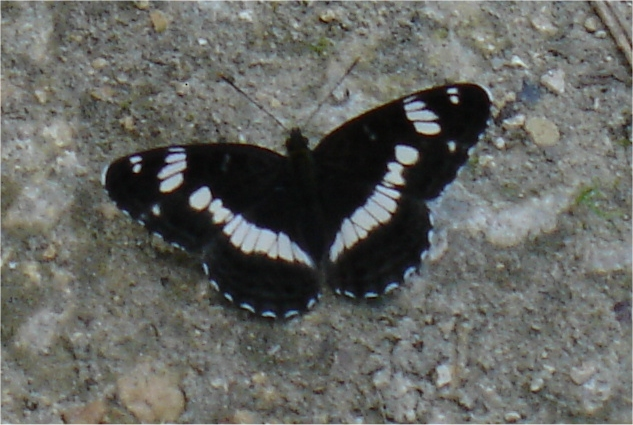
Short trail post 7: This open area is Oakmead, named after the huge multistemmed pendunculate oak which dominates the open area. The question can be posed; is this one tree that was coppiced at a much earlier date and then each shoot left to grow? If so it is old indeed, at least 200-300 hundred years. However it may be a group of trees, perhaps from a cache of nuts left by a squirrel or jay.
The tree has had surgery done to it as one bough was so heavy it almost split the tree in two. You can see the scar left as the tree healed itself.
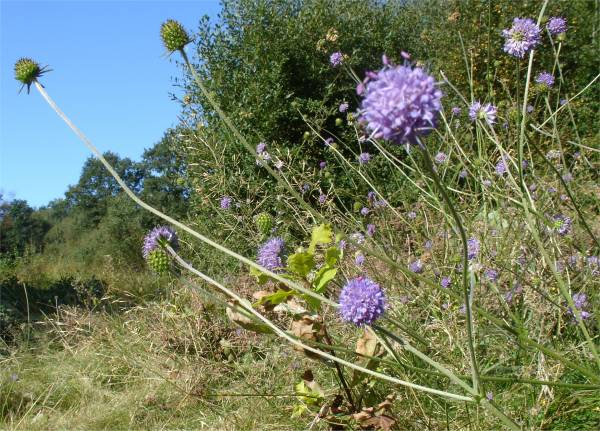
In late summer look for the blue pom-pom flowers of devils-bit scabious Succisa pratensis.
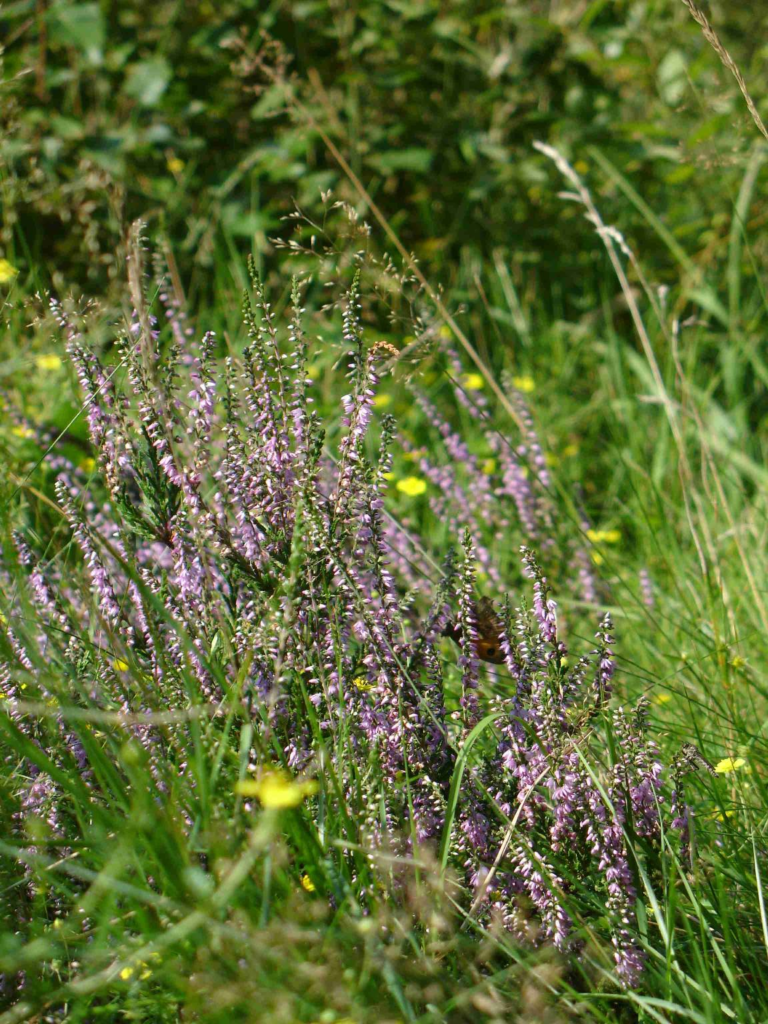
Scattered among the grass are clumps of heather (ling) Calluna vulgaris. Heather is native to Stanmore Common and is precious. It is a characteristic component of lowland acid grassland and heathland, a habitat that is increasingly rare due to loss to farming and building.
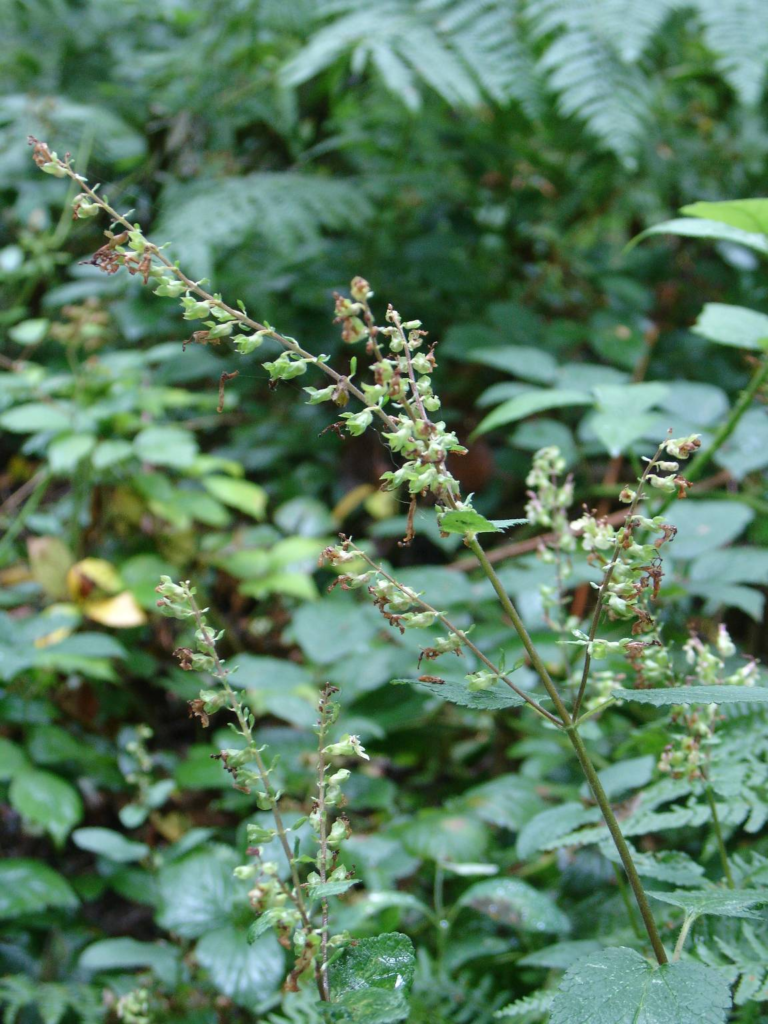
The woodland ahead is open and light and supports a good ground flora. In late summer look for the green flower spikes of wood sage Teucrium scorodonia, a relative of dead-nettle that is characteristic of acidic soils.
Short trail post 8: Behind you on the left is a magnificent pedunculate oak that lost a major limb during a storm. Trees are tough and can survive damage like this as long as the roots are intact.
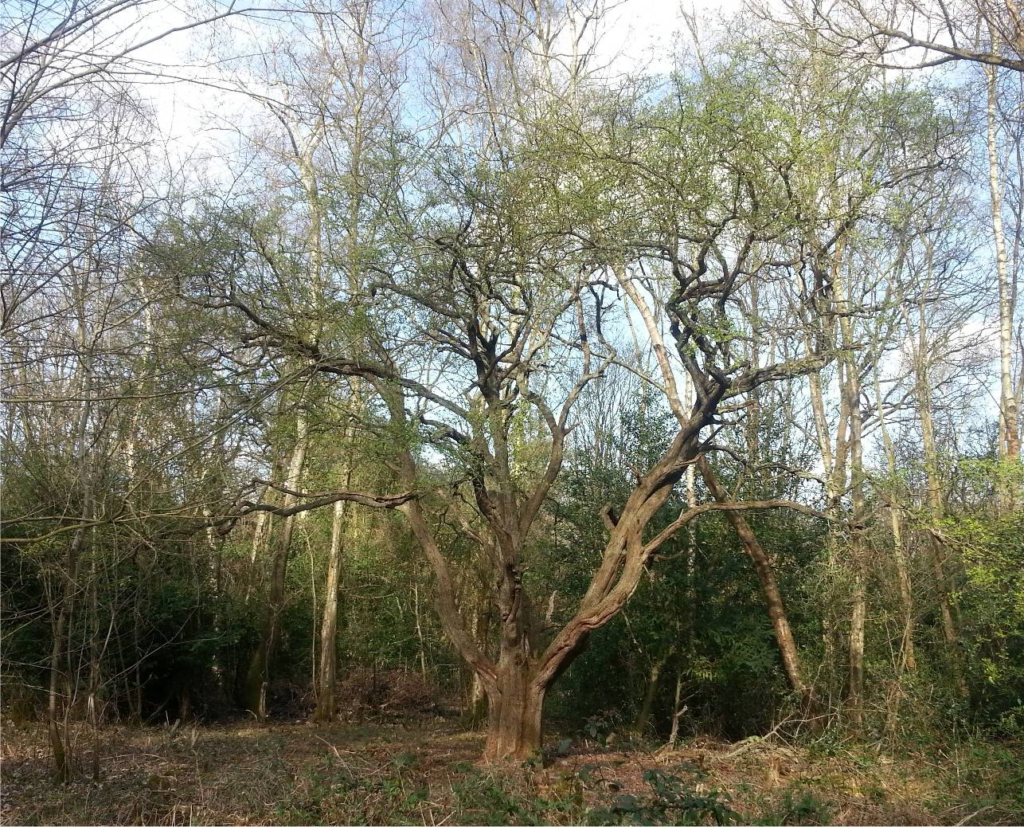
On the side of the trail oppositeto the oak you see an old tree with a stem that divides into multiple branches about 2 metres from the ground (see image below). This is an ancient hawthorn, probably over 200 years old and likely to be one of the oldest in southeast England.
Short trail post 9: On the left is a line of old oaks, much older than the young trees all around. These may once have marked the edge of a track used by commoners to remove gravel, timber or other materials that they had collected on the Common.
The next footbridge takes you over the Heathbourne Stream, the last of the Common’s streams that you will encounter on the trail.
Short trail post 10: The open area ahead and to the right is Bluebell Heath. Although one of the largest open areas on the Common, it had by 2010 been almost completely overgrown by scrub and young woodland, and we were in danger of losing all the plants of open grassland and heath together with the butterflies and other invertebrates that depend on them. In the winter of 2012-2013 much of the young trees and scrub were removed in a project supported by the Heritage Lottery Fund. The ground cover was allowed to regenerate naturally. Now the clearing is far more open yet still full of life.
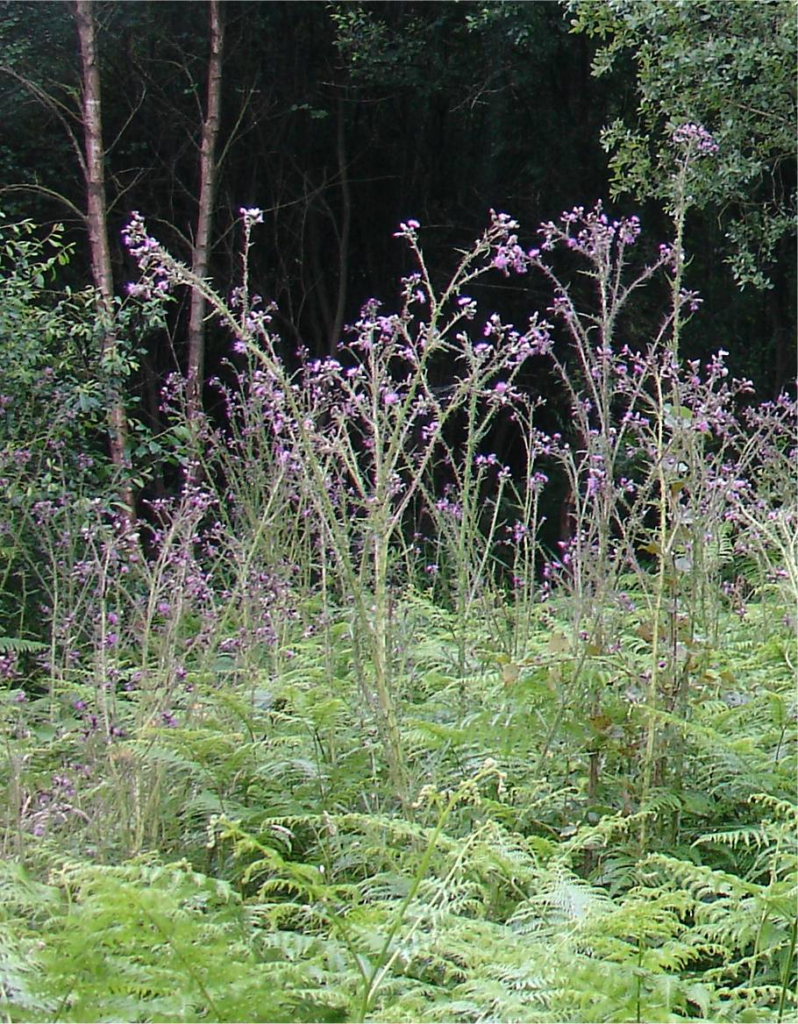
Walk up the hill to post 1 of the return trail. The tall plants on the left are marsh thistle Cirsium palustre, an indicator of mildly acidic soils with moderate fertility. All thistles are important plants for invertebrates but thistles are also highly invasive and do need to be controlled on the Common. As its name suggests, marsh thistles like damp soils. They can be distinguished from other thistles by the winged spines that run all the way up the stem.
Return trail post 1: The area to the left of the path you will follow is New Scrape. Here in the winter of 2012-2013 the secondary woodland was not only cleared of trees but the leaf litter and forest soil was scraped away to leave the bare Stanmore Gravel. By doing this we allow the growth of acid grassland and heathland plants that thrive in nutrient poor quick draining soil.
The path beside New Scrape is edged with lovely grasses. Yorkshire fog Holcus lanatus you can identify by the soft white downy hairs all down the stem, creeping soft grass Holcus mollis by the hairy “knees” or swellings at the nodes (the places on the stem where leaves emerge) and wavy hair grass Deschampsia flexousa by its very tall tussocks bearing blazing red flower spikes or panicles.
From late spring to late summer look for the yellow flowers of hawkweeds Crepis spp., relatives of dandelions. Hawkweeds are very important nectar sources since each flower head bears up to 50 individual florets and each has a nectar gland.
To your right are tall conifers. The one with fine reddish scaled bark is Scots pine Pinus sylvestris and the dark green thin needle leaved tree with thick vertical bark cracks is larch Larix decidua.
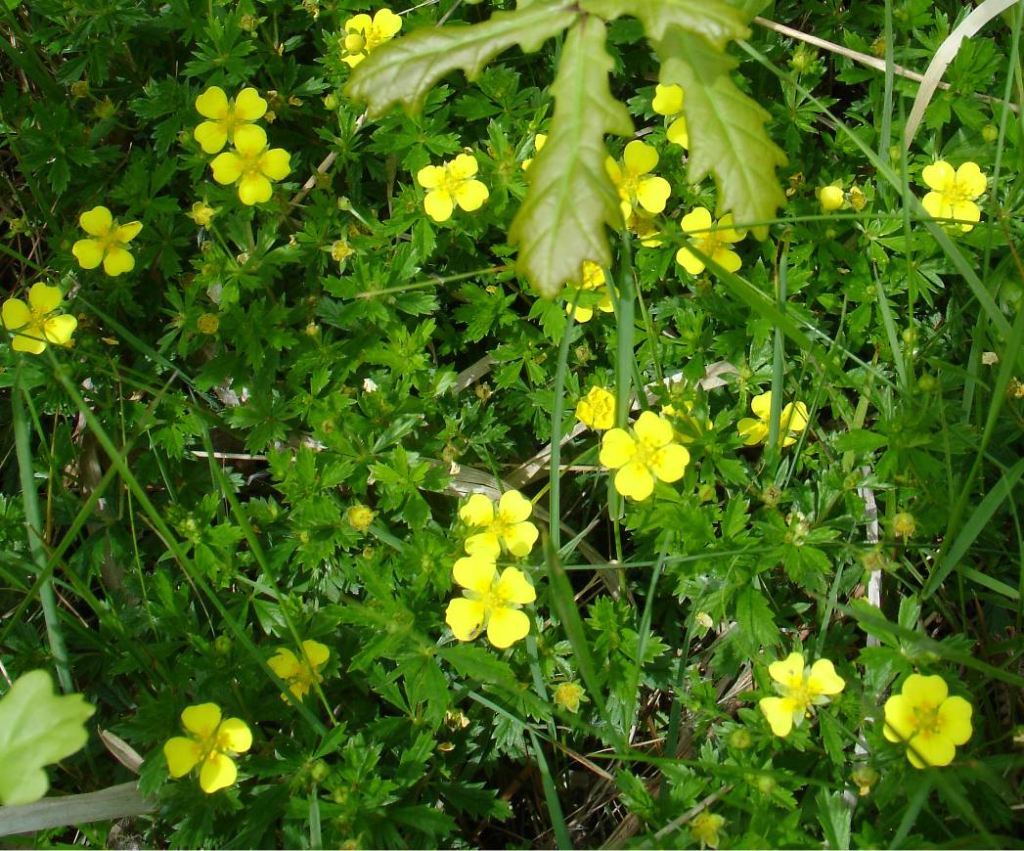
Return trail post 2: In June through September this is a good place to look for the pretty yellow flowers of tormentil Potentilla erecta growing at the base of the bracken and other plants. Tormentil is a characteristic plant of acid grassland. Like cinquefoil and strawberry it is a member of the rose family, but unlike its relatives its flowers have four, not five, petals.
The trail descends though Bluebell Heath, passing to the left of a bench – but this is a good spot to rest for a while. Butterflies abound here: red admiral, small tortoiseshell, comma, peacock, meadow brown, speckled wood and ringlet can all be seen along with the small, Essex and large skippers.
Look up from the bench to the left of the path you came on for an ancient wild apple tree that is covered in blossom in April and May. We are working to propagate it from seed and to clone the existing tree by layering.
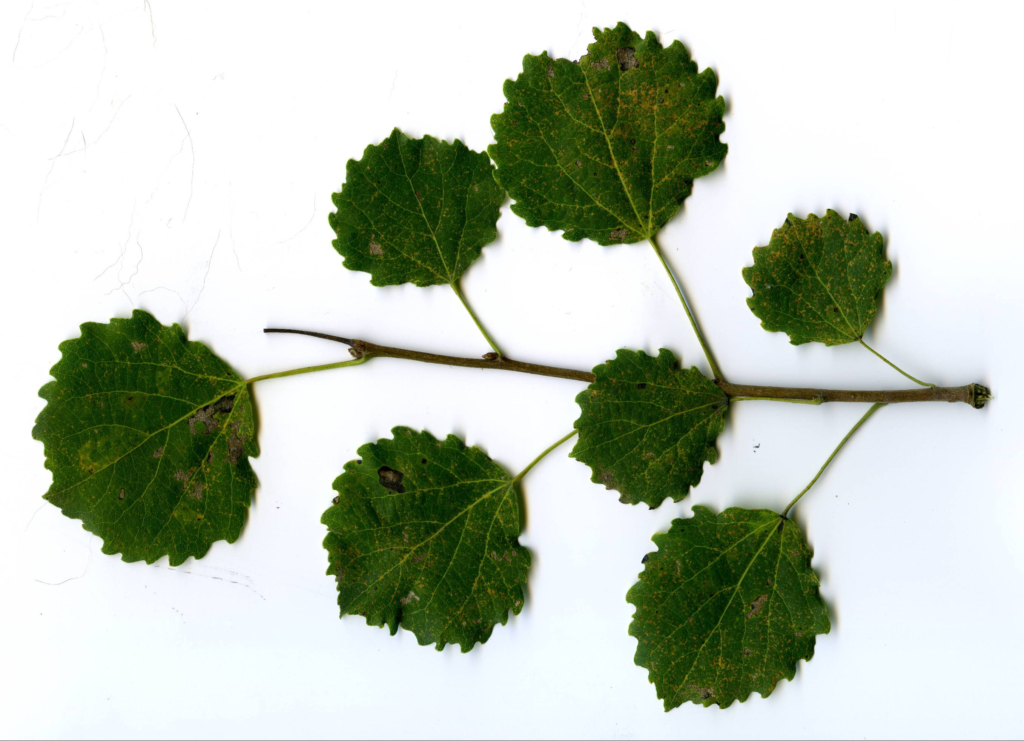
Return trail post 3: The small tree beside the post, and several nearby, is aspen, a damp loving tree. The latin name Populus tremula refers to the trembing of the circular leaves (image at right) in the slightest of breezes. This is because the leaf stalk or petiole is a flat strip that easily twists; this habit has produced the saying “To shake like an aspen”. Aspen is home to some of the reserve’s rarest insects. Because of this aspen is very rarely felled on the Common.
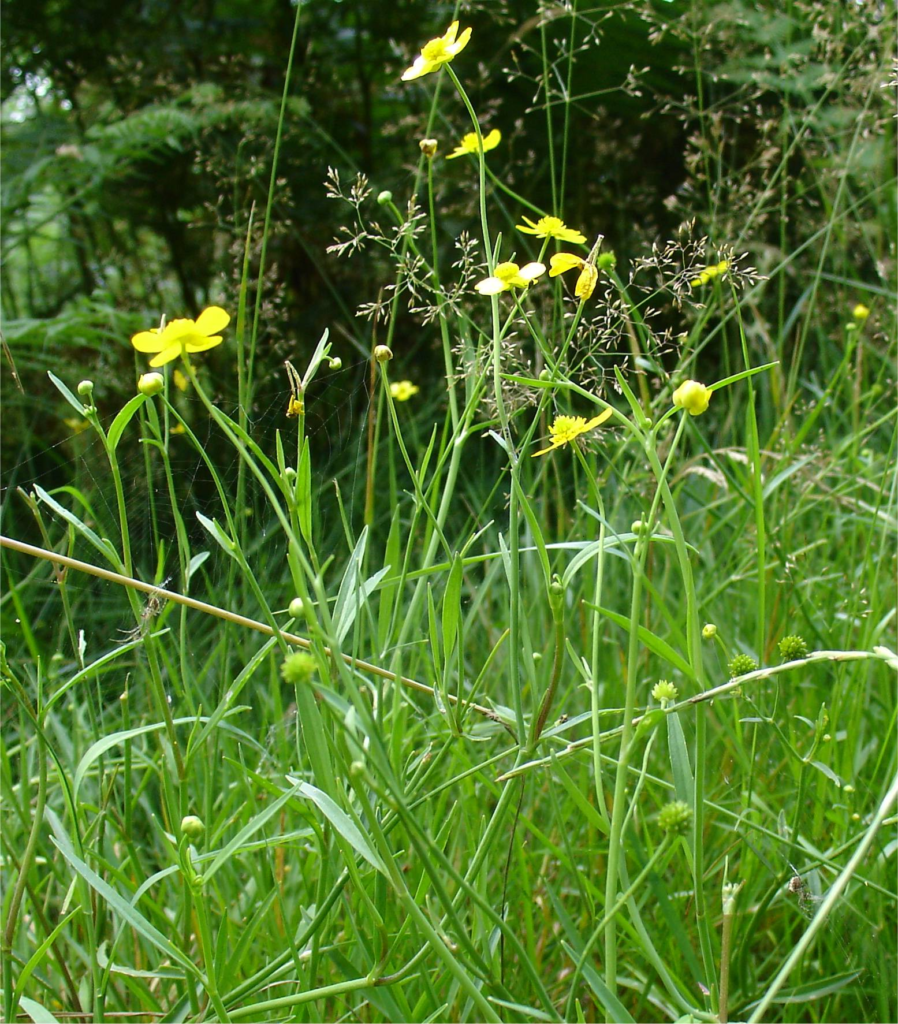
13 paces ahead on the left look in summer for the small buttercup flowers of lesser spearwort Ranunculus flammula.
Return trail post 4: This is Pynding Mersc. This is the lowest point of the reserve and all the streams flow to here. A dam that carries the horse ride has created a wetland delta used by many animals including dragonflies, damselflies, frogs, toads, newts, water beetles, herons, mandarin and mallard ducks as well as Daubenton’s and soprano pipistrelle bats.
Plants in the water include float grass, water and wood forget-me-not and gypsywort. Immediately in front of the number roundel look for narrow leaved water plantain Alisma lanceolatum with its large spear shaped leaves, bearing pretty white flowers in June through August.
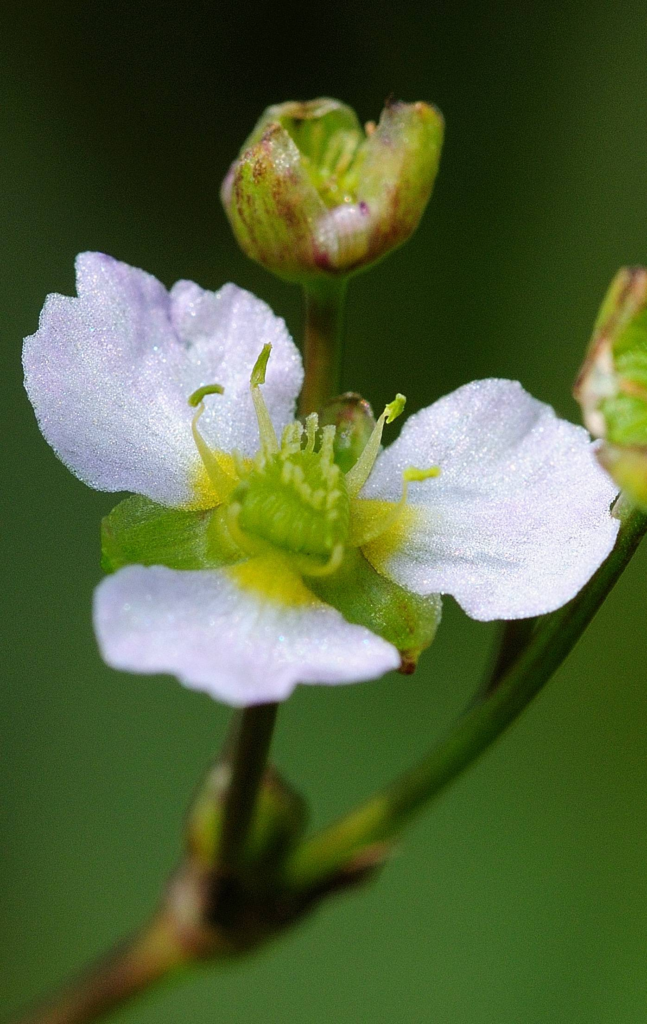
Copyright reserved, reproduced by permission.
As you walk across the footbridge notice bubbles appearing by the vertical supports. This is trapped methane squeezed out of the mud by your weight on the bridge.
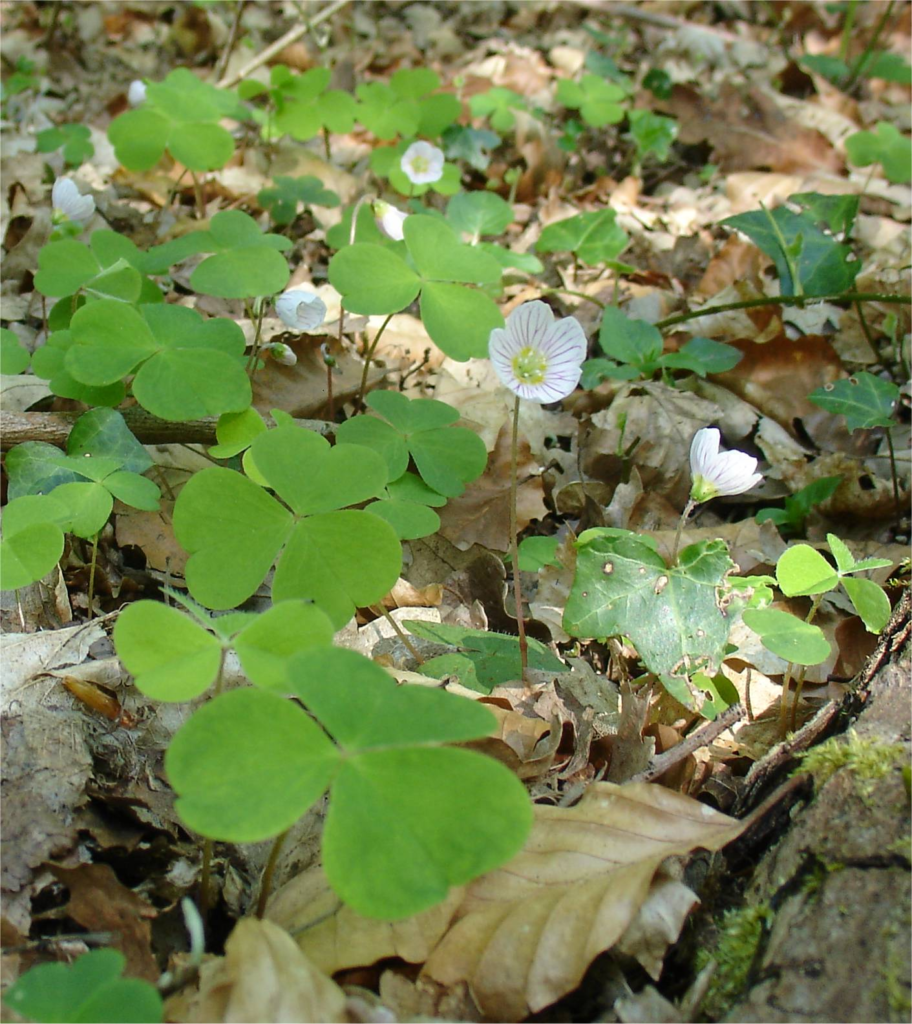
As you leave the boardwalk and begin climbing the slope look on the right in spring for wood-sorrel Oxalis acetosella. The leaves have three independent leaves, like clover, and the very pretty white flowers appear in April and May.
Return trail post 5: This clearing is called Hollybrook Rise after the stream that flows to its west. Like the other open areas on the reserve it is cut by hand to create a complex mix of low and high vegetation including small miniclearings which will catch the sun but are shielded from the wind by a sparse covering of bracken and taller uncut vegetation. Look in particular for the acid grassland specialist heath bedstraw Galium saxitile with its sprays of tiny white flowers, and heath wood-rush Luzula multiflora with flowering heads like bulbous brown balls.
Return trail post 6: This open space under four great trees is Witling Glade. A great oak tree has fallen close to the trail bollard. Compare the bark on this oak tree to the living beech to the right. Notice the dramatically different bark; oaks have rough bark, resembling poorly laid cobblestones, while beeches, even mature ones like this, are smooth. Ahead are two more mature trees: one is a beech, one is an oak – can you tell which is which just from the bark?
Return trail post 7: Turn left uphill for the final stretch back to the car park. Many of the plants found on this stretch are indicators of high nutrient levels such as greater plantain Plantago major, creeping buttercup Ranunculus repens, stingling nettle Urtica dioica and the tough wiry perennial rye grass Lolium perenne with its double row of oval florets going up the stem.
The high nutrients come primarily from dog waste. The delicate wild flowers seen elsewhere on the Common would be crowded out by these ranker plants if nutrient levels rose; this is another reason, in addition to considerations of public health and unsightliness, why dog waste must be bagged and placed in waste bins or removed from the site.
More on some of the birds you are likely to see or hear on the Common
More on the three species of deer on the Common and their tracks