Welcome to the Stanmore Country Park nature trail. The trail was designed by the Harrow Nature Conservation Forum. Hardware and installation were funded by Harrow Council’s Green Grid project. The nature trail comprises two loops – a northern loop one kilometre long and an eastern loop 1.3 kilometres long. They can be walked independently, or combined into one trail.
If you are starting at the Dennis Lane car park, post 1 is a few metres away, at the start of the boardwalk by the pond.
If you are starting at Kerry Avenue, post 24 is a little way ahead up the main track.
We hope you enjoy the trail. Please send any comments, photographs, and notes about interesting species seen to admin@harrowncf.org.
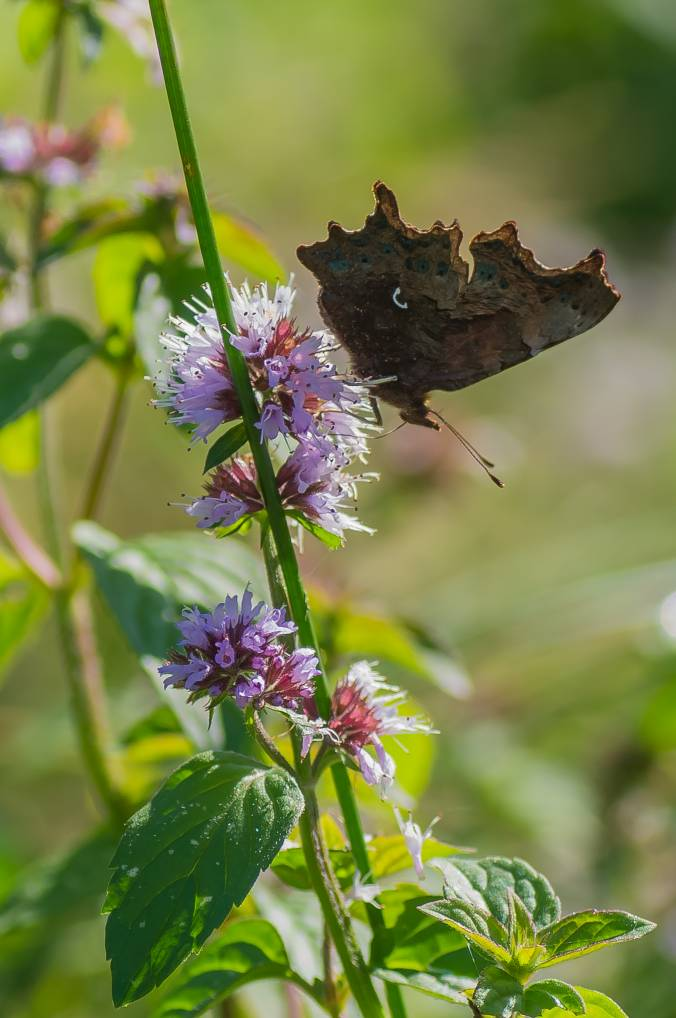
Post 1: Ahead is the lower of two artificial ponds built to balance the flow of water down Cloisters Brook. In spate the ponds fill, reducing the risk of flooding downstream. Look for reed mace Typha latifolia and Water Mint Mentha aquatica (see below) which bears attractive pink flowers in late summer. Crush a leaf in your fingers and sniff – this is a real mint! Follow the boardwalk to post 2.
Post 2: Ahead is a single small specimen of alder Alnus glutinosa. Alders love wet places, although they can tolerate drier locations and are often planted as street trees. They bear characteristic dark fruits that resemble pine cones.
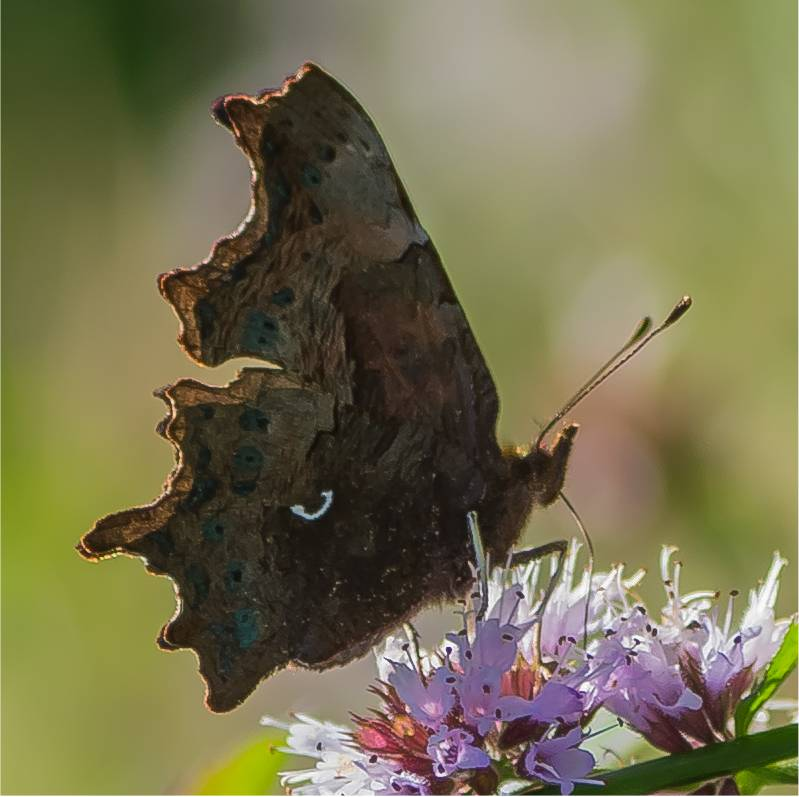
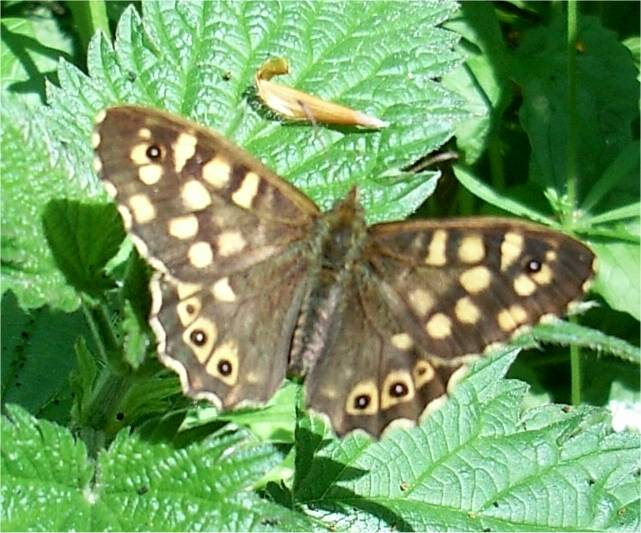
To the left is a copse of aspen Populus tremula. The leaves, borne on long flattened stalks, quiver in the slightest breeze. Aspen trees sucker prolifically, and you can see many sapling-like shoots in the grass to the right of the path growing from the roots of the trees. Without its annual mowing the open grassland would rapidly become aspen scrub. Turn left and follow the well trodden path. This is a good place to see butterflies including the comma and speckled wood (see illustrations above), gatekeeper, common blue and small copper.
At the edge of the woodland note the small trees of goat willow Salix caprea on the right. This bears yellow catkins in early spring and attracts many insects that have just emerged from hibernation and are seeking nectar. The path curves right, entering woodland to reach post 3.
Post 3: Stanmore Country Park is rich in fern species. The prominent fern immediately opposite the post is the western (or golden) scaly male fern (Dryopteris affinis). Around it are many specimens of male fern Dryopteris filix-mas and broad buckler fern Dryopteris dilatata. Borrer’s scaly male fern Dryopteris borreri and the narrow buckler fern Dryopteris carthusiana also grow in this area.
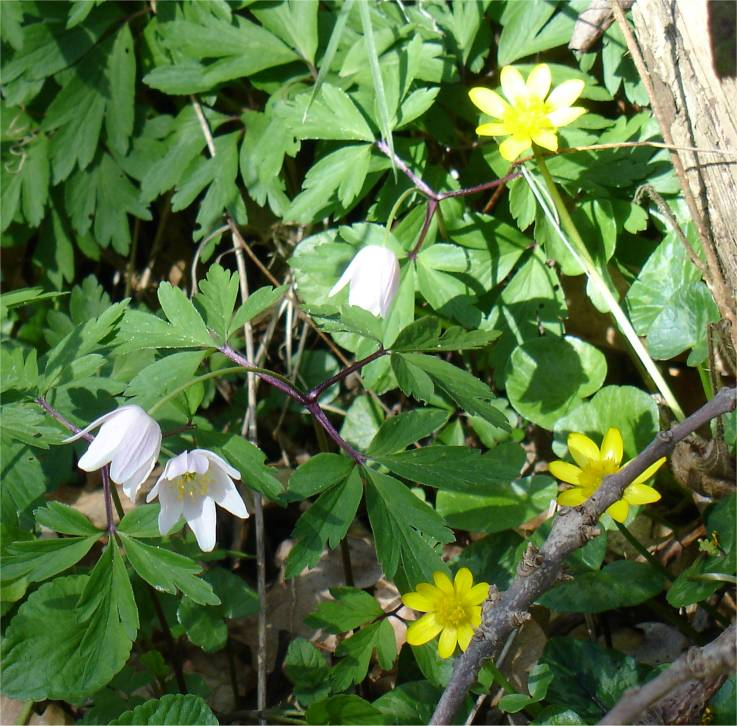
In spring this section of woodland is lovely with flowers including wood anemone Anemone nemorosa and lesser celandine Ranunculus ficaria (see below). Lesser celandine is a close relative of the buttercup and has very similar shiny yellow flowers. It comes into leaf and flowers in early summer, before the trees have come into full leaf. As soon as it is too dark for useful photosynthesis, all the plant above the ground yellows and dies, storing its nutrients below ground in a corm that looks rather like a dried fig, hence the plant’s scientific name.
Post 4: Here the nature trail meets the London LOOP link path. The London LOOP is a 152 mile circular route around the whole of London, and runs just north and west of Stanmore Country Park, through Bentley Priory and Stanmore Little Common. The link path gives access to the main LOOP from Stanmore Jubilee Line Station, and provides a well signposted, largely off-road route from the station to Stanmore Common.
From post 4 the northern and eastern nature trail loops diverge.
The full trail, using both loops, is about 2.3 km long. To do this, turn left over the bridge and follow the path uphill to the finger post, where you turn left.
Also turn left if you intend to do the northern loop only, which is about 1 km long.
To follow the eastern loop only for a total walk of 1.3 km, bear right to post 13. If you started at the Kerry Avenue entrance, this is the shortest route back to your starting point.
Post 5: This is Spinney Field, a narrow grassy ride that is rich in meadow wildflowers. In April, May and June look for the violet-pink blooms of cuckoo flower Cardamine pratensis. Like all crucifers, the four flower petals are arranged in a simple symmetric cross. At the same time of year look for the orange-tip butterfly, whose caterpillars feed on cuckoo-flower. Males are unmistakable, with orange tips to their forewings, while females are all white.
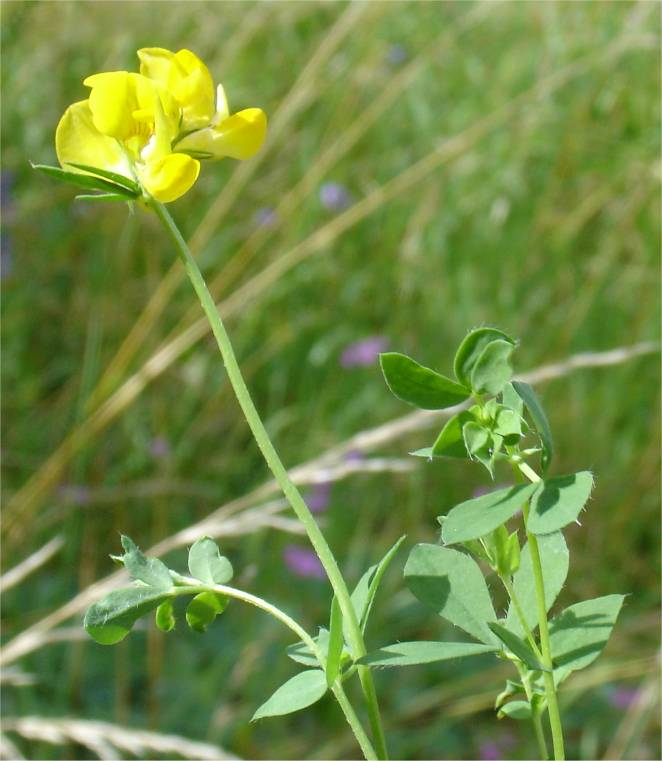
From June to September look for birds foot trefoil Lotus corniculatus twining through the grass (see illustration below). The pretty yellow flowers are tinged with red as they emerge from the bud, giving the plant its alternative name of bacon and egg plant. There are in fact two species found here, the common birds foot trefoil and the greater birds foot trefoil which is distinguished by its hairy flower buds and leaves.
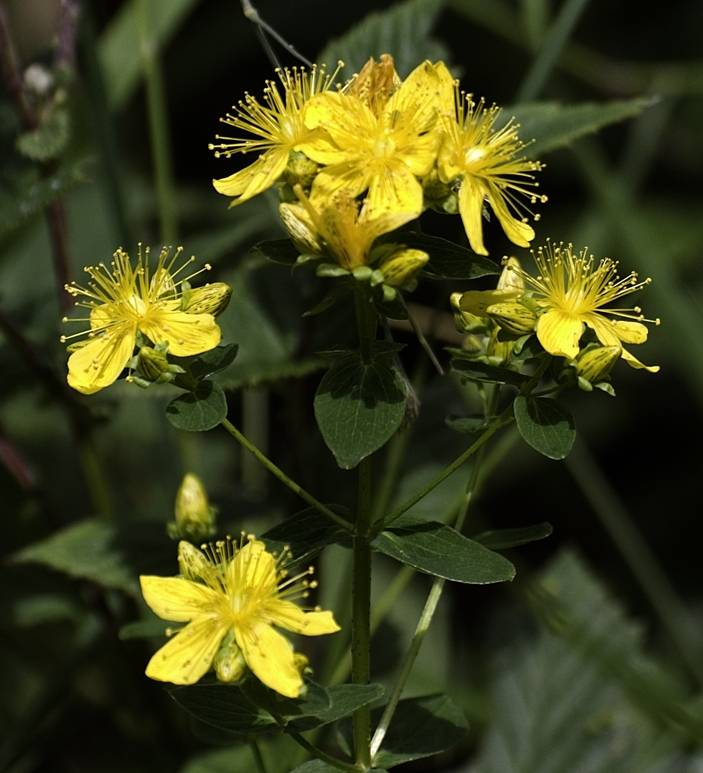
Look also for square stalked St John’s wort Hypericum tetrapterum (see illustration below). Like all St John’s worts this has attractive yellow flowers with five petals; the square stalk of this species is obvious when rolled between the fingers. In autumn the plant bears bright red berries. The trail now leads up the ride.
Post 6: When we wrote this guide in 2012 this was a magnificent healthy ash tree Fraxinus excelsior that bore many bunches of the seeds known as ash keys. Sadly, it may fall victim to ash dieback disease caused by the fungus Chalara fraxinea, which was first detected in England in the autumn of 2012. In affected trees the leaves wilt and then go brown and crisp, starting with the midrib or main vein. Another sign is masses of whitish-beige small cup fungi on fallen twigs below infected trees.
Post 7: At this point the ride widens into Spring Meadow. Beside the post is a Siberian crabapple, Malus baccata. This species is native to East Asia so how it came to be here is a mystery. In April through May it is lovely with white blossom, while in the autumn it bears many tiny red fruits, less than a centimetre across.
Ahead in the centre of the meadow stands a fine spreading oak tree. Like all the oaks in the Park this is a Pedunculate Oak Quercus robur, the predominant species in the south of England. It is worth getting close to the branches to see the many brightly coloured lichens.
From this point, continue up and round to the right. The path dips to the spring that gives this field its name, but the route is good in all but the wettest weather. On the other (eastern) side of the spring, continue through a narrow gap then hug the edge of the woodland on the right (at times this is a rather indistinct path) to post 8.
Post 8: To the right of the post is a small tree of cherry plum Prunus cerasifera. Although not a native to Britain, it is common, in part because it was often used as the rootstock for other commercial plum varieties. Cherry plum is one of the first trees to flower in spring. There are many cherry plum trees on Wood Farm to the north that flower when the season still seems stuck in winter.
From this point, continue along the edge of the clearing, crossing the London LOOP Link path.
Post 9: To the left is an isolated clump of young sycamore whose broad leaves develop large black spots in high summer. These are caused by the Tar Spot Fungus Rhytisma acerinum. The fungus was seen only rarely in London a few decades ago, because it was sensitive to air pollution. The presence of the fungus, which does no great harm to the host tree, is therefore a welcome sign of the cleaner air we now enjoy.
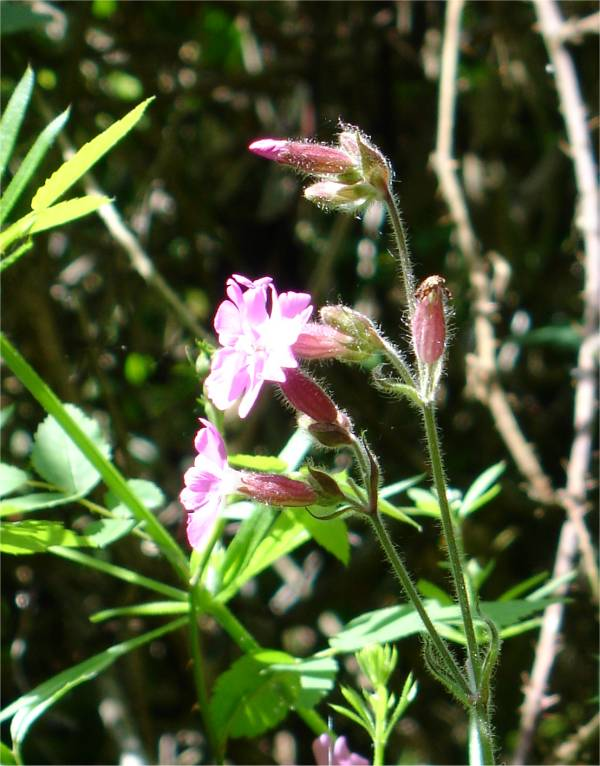
Look for red campion Silene dioica under the sycamore. There is a chance of seeing flowers all the way from March through October. The flowers have five petals, each deeply divided – see illustration below.
On the other side of the row of fence posts is a prominent line of male fern Dryopteris filix-mas. Follow the path to the right into the woods. Soon you pass a rather eerie area of blackthorn trunks coloured red by the filamentous alga Trentepohlia.
Post 10: In 1968 a linear clearing was created when a gas main was laid. These birch trees have grown to their present size since that date. Birch has tiny winged seeds that are carried long distances by the wind and is one of the first trees to invade open ground. However birch trees cannot compete with the slower growing oaks, which eventually shade them out.
In winter, the view to the left as you descend the path from this point is dominated by the looming mass of Wood Farm on the other side of the stream valley. The height was increased from 1970 to 2000 through the dumping of building rubble. Wood Farm opened to the public in 2015 and is a wonderful site especially for breeding birds. At the top is a viewpoint with spectacular views over London.
Post 11: The large oak tree to the right is at least 200 years old, much older than the smaller trees that surround it. Until 1950 Stanmore Country Park comprised open fields separated by hedges, and this tree stood in a hedge. The routes of the hedges can still be made out, delineated by these giant oaks that dwarf the 60 year old trees around them.
The path ahead crosses the Cloisters Brook then climbs steps up onto Wood Farm. If you do not know Wood Farm, it is worth going to the top of the steps to get the impression of this very different site. However the Stanmore Country Park nature trail turns right here onto the narrow path leading past the old oak.
Post 12: Cloisters Brook runs here in an attractive little valley where hart’s tongue fern Asplenium scolopendrium, soft shield fern Polystichum setiferum and lady fern Athyrium filix-femina grow. The large shrubs to left and right, with leaves with a pointy “rainspout” at the tip, are hazel. A little way ahead the path passes through a gap in a fallen oak – another of the giants that used to stand in the hedgerows. The top of the fallen tree is now a wealth of vegetation, including male fern and broad buckler fern Dryopteris dilatata.
As you continue down Cloisters Brook, look out for leaky dams constructed to slow the flow during times of spate to reduce the risk of flooding downstream as well as create a new water habitat.
On reaching the main path, turn left to regain post 4. From here turn right to return to the car park, or left to continue on the eastern loop of the nature trail.
Post 13: The spiky bush is the midland hawthorn Crataegus laevigata. Botanists can distinguish the midland hawthorn from the more widespread common hawthorn Crataegus monogyna by counting the styles; it has two styles per flower where the common hawthorn has one. An easier way is to pick ten or so fruits and, squashing them between your fingers, count the number of seeds in each fruit. A pure midland hawthorn will have two seeds per fruit; a pure common hawthorn will have one. Hybrids are common and will have a seed per fruit average between 1 and 2. The leaves differ: common hawthorn leaves tend to be more deeply divided than those of the midland hawthorn – see illustration below. However, leaves of all shapes can be found on a single bush, so leaf shape is a poor method for distinguishing the two species.
As you continue up the hill you pass though woodland of oaks with a few birches. Until the Second World War this area was open fields separated by hedges; when grazing stopped after the war secondary woodland grew up. All the trees you see here are therefore under 60 years old.
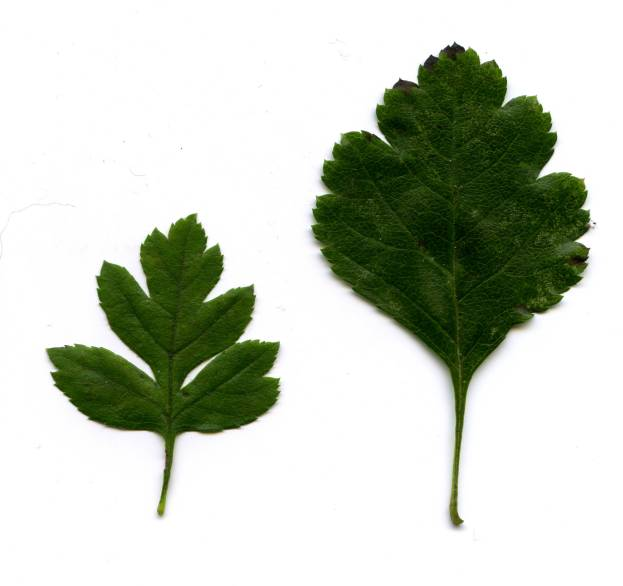
Post 14: Here we cross one of the ancient hedge lines. The oak to the left is about 250 years old, and a line of similarly large oaks can be seen behind it standing on a raised earth bank. The tree on the right is a hornbeam Carpinus betulus. Hornbeam wood is extremely hard and used to be used for gear wheels, for example in clock mechanisms.
Post 15: This clearing is all that remains of Upper Blue Pond Field. The gorse (Ulex europaeus) bush growing here reveals that the soil is stony and acid, supporting a different population of plants to those growing in 6 Acre and Spring Fields to the west.
Post 16: By 2000 the growth of oak and birch secondary woodland meant that the few remaining open areas in Stanmore Country Park were small and separated from each other by belts of woodland. The plants and animals in such glades are at great risk of local extinction. For this reason management since 2000 has focussed on clearing woodland to join and enlarge the open grassland areas. The area to the left was cleared of birch woodland in the winter of 2012-2013 to connect Upper Blue Pond and John Hall’s Fields.
As you climb the low bank just ahead, note the rounded pebbles of the Stanmore Beds. It is these pebbles that create the fast draining, acid soils of Upper Blue Pond and John Hall’s Fields. The origin of the Stanmore Gravel is uncertain, although it is certainly recent – Pliocene to early Pleistocene, that is, 5 million years old or less. One theory states that the pebbles were deposited in tributaries of the ancient Thames. However, they look more like the pebbles of a stony beach.
Post 17: Here we meet an old trackway that descended from Bushey on the left towards Stanmore and beyond to the right. For many years the route has been blocked by the private land of Wood Farm to the north, but now one can follow the route through Wood Farm up to Wood Lane on the top of the hill.
In the past this area has been dominated by plants such as bramble and rose bay willowherb – plants collectively called “ruderal” meaning that they are characteristic of disturbed, uncared-for land. Management in this area is aimed at reducing the amount of such plants and restoring the acid grassland. Volunteers pull up bramble by the roots, or cut bramble and willow herb with brushcutters and scythes. However from 2017 a more natural approach to maintaining and restoring grassland began in one of the open areas; we will see this in action later on the trail.
Post 18: This clearing is all that remains of John Hall’s Field. By 2000 the open area was reduced to the size of a garden lawn, but management by the voluntary warden John Hollingdale and other volunteers has increased it to its present size and linked it to 40 Acre Field to the south. The soil here is quick draining and acid, as in Upper Blue Pond Field, and there is a profusion of gorse together with other plants of unimproved grassland including common bent, yorkshire fog, early hair-grass, heath bedstraw, tormentil, hawkweed oxtongue and lesser stitchwort.
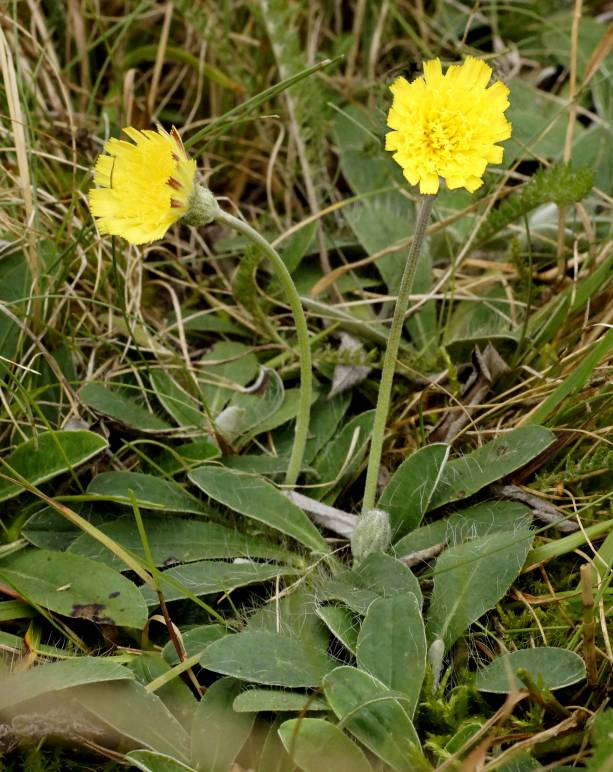
Beside the post is a hummock in the grass: this is an ant hill occupied by the yellow meadow-ant Lasius flavus, there are many more in the glade ahead. The ants are the main food for green woodpeckers, which are common in the Park. Abandoned ant hills can be seen in many of the now wooded areas of Stanmore Country Park and bear witness to the encroachment of previously open grassland by trees. The dry summits of the ant hills support a specialized population of plants such as sheep’s sorrel. In May through August look on top of the ant hills for the pale yellow dandelion-like flowers of the mouse-ear hawkweed Pilosella officinarum (see below). The undersides of the simple oval leaves are covered in a felt of white hairs, suggesting mouse ears.
In March 2016 contractors cleared a lot of encroaching birch scrub.
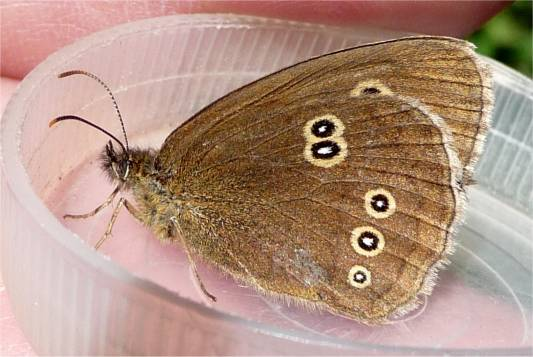
Post 19: This ride through young secondary woodland was created in 1998 to link John Hall’s Field and 40 Acre Field to the south. It is a good place to see Ringlet butterflies, which are active in late June and early July (see illustration above).
We believe the hawthorn bush here to be a pure common hawthorn Crataegus monogyna. See if you agree with us! Pick ten or so fruits and, squashing them between your fingers, count the number of seeds in each fruit. As noted before, a pure common hawthorn will have one seed per fruit; a pure midland hawthorn Crataegus laevigata will have two. Hybrids are common and will have a seed per fruit average between 1 and 2. The leaves differ: common hawthorn leaves tend to be more deeply divided than those of the midland hawthorn – see illustration above at post 13. However, leaves of all shapes can be found on a single bush, so leaf shape is a poor method for distinguishing the two species.
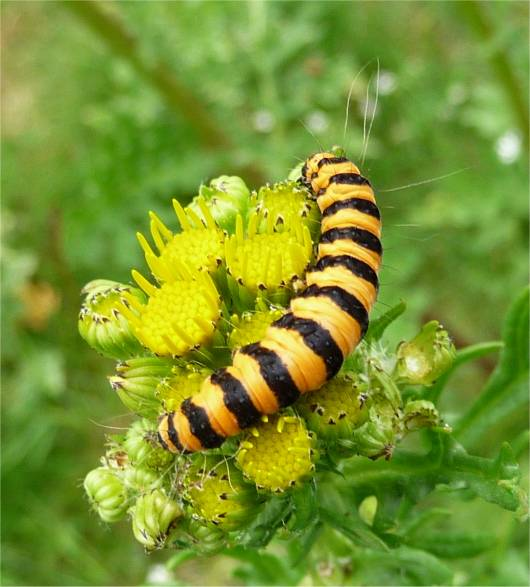
Post 20: Coming through the kissing gate you leave the fast draining Stanmore and Claygate beds for the heavy London Clay which supports a lusher grass community. Ahead is 40 Acre Field, the largest of the open grassland areas in Stanmore Country Park. In summer, look for ragwort (Senecio jacobaea) with its yellow daisy-like flowers. In July and August you should be able to find caterpillars of the cinnabar moth, which eat ragwort and accumulate toxin from the plant in their tissues; their pattern of yellow and black stripes (see illustration below) warns birds not to eat them.
In winter, look back into the woods on the right of the way you have come to find a prominent pale dead tree. This is such a strange, tortured shape that we feel it should have a name – can you think of one? As far as possible, dead trees are left standing and act as a food resource for a wide range of invertebrates that cannot live in the wetter conditions in fallen trees on the ground.
Post 21: In the summer, 40 Acre Field is a sea of yellow meadow buttercup Ranunculus acris. From this point we have a good view over London. Wembley Stadium is clear on the right, but can you find the Shard, the BT Tower and the London Eye? On a clear day one can see the North Downs beyond the London basin.
Flowers to see in the grassland in spring and summer include creeping buttercup Ranunculus repens, cuckoo flower Cardamine pratensis, common vetch Vicia sativa and greater stitchwort Stellaria holostea.
Post 22: Up to 2017 40 Acre Field was kept open by yearly mowing, but in that year a small herd of cattle was introduced. Since cattle graze unevenly, taking some clumps down to the ground and leaving others standing tall, the complexity of the grassland structure is increased resulting in improved biodiversity.
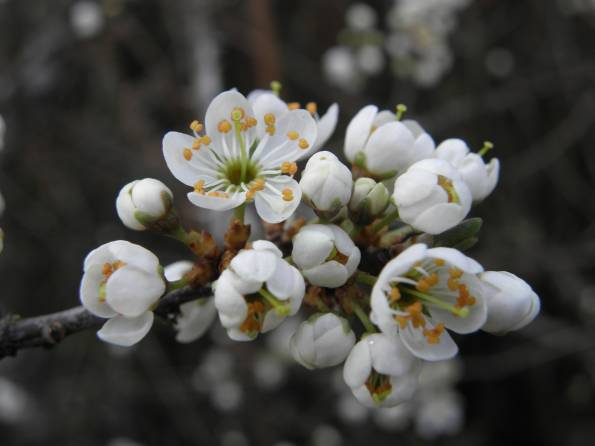
Post 23: From this point the trail runs along a loose hedge that contains a good mixture of bushes and climbing plants. In early spring look out for the lovely white blossom of blackthorn Prunus spinosa, borne on bare twigs protected by vicious spines (see illustration below). Fertilized flowers then form small plum-like fruits called sloes which are too bitter to eat but which are used to flavour gin. Later in spring the hawthorn blooms, along with elder (Sambucus nigra) and a small apple tree (Malus pumila). In June dog rose Rosa canina, which clambers over the bushes, has its all too brief flowering, and later bears red hips.
From here the trail heads towards a 5 bar gate out of 40 Acre Field. Turn right along the wide path to continue the nature trail, or turn left for Kerry Avenue.
Post 24: At this point we bear left off the main north-south path and enter a small area of woodland that has masses of bluebells Hyacinthoides non-scripta in early summer.
Post 25: Although oak dominates the woods on Stanmore Country Park, many other tree species are found. Here are young examples of two trees that are often confused: hornbeam on the left, and beech Fagus sylvatica on the right. Side by side, it is obvious that the leaves of beech are glossier. In winter, beech is readily identified by its long, pointed buds, while in late summer the two trees bear very different fruits. The hornbeam bears bunches of winged seeds that hang down before detaching and spinning off. In contrast the large seeds, or mast, of beech are held in hairy cups, very similar to those of its close relative the sweet chestnut.
Post 26: Just down the slope to the left of the path are three trees with obvious horizontal banding. These are the wild cherry or gean Prunus avium, which unlike the cherry plum we met on the northern loop grows to be a full size forest tree. In March and April look up into the crowns to make out the blossom.
The large depression at the bottom of the slope is what remains of Blue Pond, a reservoir created in 1720 to hold water for supply to Cannons, a house built by James Brydges, First Duke of Chandos and famed as the most expensive of its day. The fragments of brick wall that can be seen at the foot of the slope presumably date from this time. From this reservoir, water flowed in pipes of hollowed elm tree trunk to a fountain in the garden. Cannons house lasted less than 40 years; it was demolished in 1747, and a much smaller villa built in 1760 in its place. This later house remains as the North London Collegiate School for Girls.
Up in Pear Wood to the northeast a second water reservoir for Cannons remains intact and is now maintained as a fishing lake.
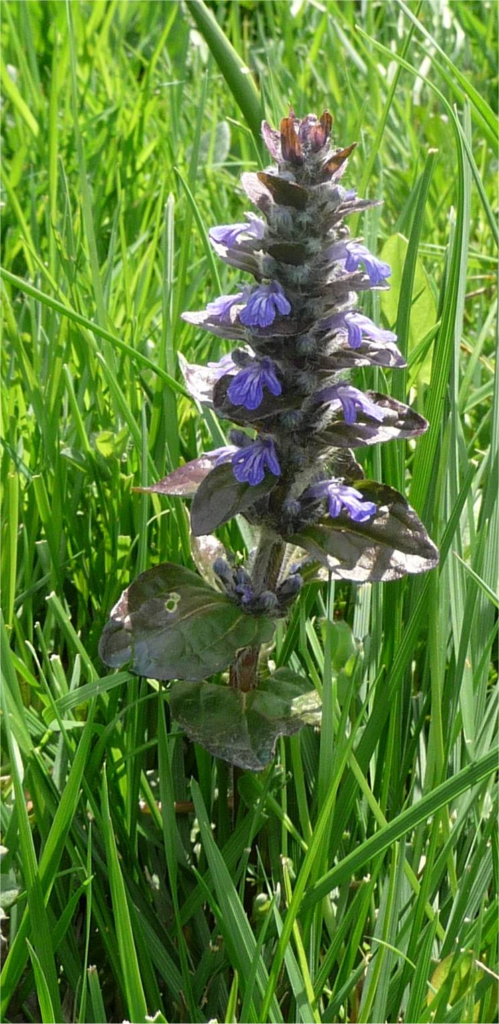
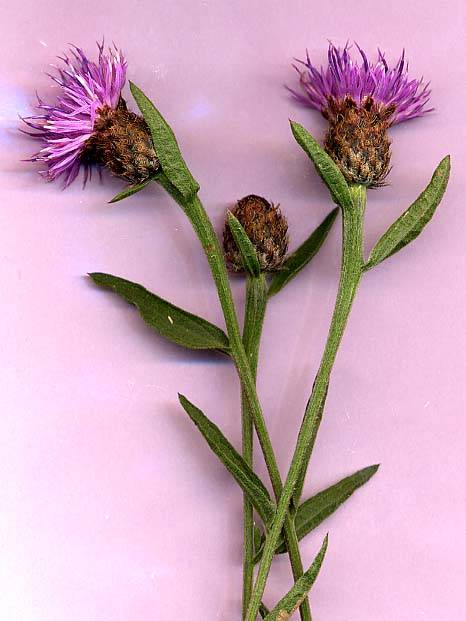
Post 27: Here we re-emerge into 6 Acre Field, with the car park just ahead. The grassland here is on London Clay and has a similar species mix to 40 Acre Field. In early summer, look for the pagoda-like spikes of bugle Ajuga reptans in the grass (see illustration below). Later in the summer, look for the purple flowers of common knapweed Centaurea nigra (see illustration below) which are a favourite with butterflies.
You’ve come to the end of the nature trail – we hope you have enjoyed it. Please send any comments, photographs, and notes about interesting species seen to admin@harrowncf.org.
If you started the nature trail midway, continue back to your starting point by descending though the field and finding post 1, which is just to the right of the car park, beside the pond.