Post 1: Welcome to Stanmore Common. This place is a council owned nature reserve of around 122 acres of mixed woodland, wetland and grassland. The reserve is bisected by Warren Lane, the last unlit road in the borough. The majority of the reserve lies north of the road and this is the direction you are facing at the start of the trail.
Topographically the reserve is a shallow valley with the highest point on the corner of Warren Lane and the Common and the lowest point away to the northeast which lies to your front right. The trails will cross the grain of the valley so it will gently descend and ascend. The steepest slope is up from the lowest point back towards the car park.
The soil structure of the reserve is impermeable London clay topped by pebbles. This means that water is NOT free draining and lies near the surface. When it rains water discharges from springs and so the reserve is always damp and often very wet and muddy underfoot, especially in autumn and winter.
The reserve is very important because of its rare habitats and wildlife. It is rated a Site of Metropolitan Importance to Wildlife and is fully protected by law as a Local Nature Reserve.
Historically the site was part of a much larger open area, and was a Common a site owned by the people and used for grazing, shooting, gravel extraction and breeding rabbits. As you go around the trails you will see evidence of some of this human activity.
Both routes will take you through the main habitats and both will pass interesting features which one can see or hear at all or sometime in the year. The reserve is visited by Bats, Badgers, Deer and Foxes. There are Snakes, Mice, Voles, Frogs, Toads and much more. Its insect life is rich (the site is wet/damp and Mosquitos and biting midges are common) and there is a good range of plant species some are very uncommon.
Taking your time when you go around and being quiet at the stopping points maximises your chance of seeing and hearing the wildlife. If you see something nice do record it and send it to us.
Please respect the wildlife and do not collect wild flowers or fungi (You can go badly wrong with fungi if you do not know what you are doing). It is also important to collect all dog waste and dispose of it in bins or take it away with you. The delicate wild flowers that live the Common are crowded out by ranker plants wherever dog waste adds nutrients to the soil.
From here at post 1 you can follow the Long Trail (red arrows) or the Short trail (blue arrows). These meet in Bluebell Heath at the north of the Common from where a single Return Trail (orange arrows) brings you back here. Including the return leg, the Long Trail is 1.2 miles and the Short Trail is just under one mile long. For the longer trail follow the red arrow into Jake’s Path to the left.
You will see 2 sets of picnic benches. The old set has been here for decades and they were replaced last year by the new ones. We kept some of the old ones as they have nice moss colonies on them.
Long trail post 2: This is Holly Brook, one of the many streams on the Common. The streams used to flow all year around but now flows are sporadic due to drier summers.
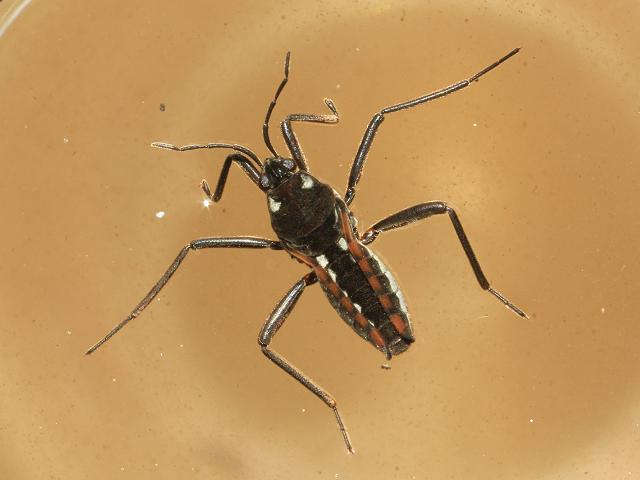
In summer look for water crickets upstream of the bridge. These are not crickets but are members of the Hemiptera, the True Bugs. They skate on the water surface like Pond Skaters but unlike the latter have bent front legs (see image). Both pond skaters and water crickets are predators on drowning insects, detecting them by sensory hairs on their legs.
A close look at the stones in the stream will show tiny snails who graze microscopic plants from the hard surface. These are Hydrobia snails with 5 UK species.
The water is unpolluted by the time it reaches the lower valley and pollution sensitive insects such as stoneflies appear.
Finally look to your left along the bank of the Holly Brook. Small mouse like mammals called Bank Voles have been seen here.
Just beyond the footbridge on your right is a colony of Broad Buckler Fern growing on the root plate of a fallen tree. This fern is identified by the brown scales down the stem. The scales have dark centers.
As you continue uphill you can see lots of fallen and dead trees. It is policy on this reserve to leave dead trees intact as part of the natural decomposition and regeneration of the woodland. The trees leave important holes in the tree canopy, allowing light in.
As you continue just beside the path are many Rowan trees with their smooth grey bark with the characteristic horizontal breathing pores or lenticels. These trees are spread by birds pooing out the seeds from the berries.
Many trees here are covered in ivy a climbing evergreen plant. Ivy does not kill trees and it is a very valuable resource, flowering very late in the year. Ivy honey is beautiful. Ivy is the foodplant of the Holly Blue Butterfly and bats prefer ivy covered trees to nest and roost in.
Long trail post 3: At the base of the post is a pile of Stanmore Gravel dug to create the post hole. The stones are rounded, indicating that they were tumbled in a river or beach. The Stanmore Gravel is recent; it was deposited only 2 million years ago – in contrast, the dinosaurs died out 65 million years ago.
To the left of the path notice a young bushy sweet chestnut. This tree is too young to produce fruits, but even mature trees only produce nuts worth eating in exceptional years.
Fork left here and follow Jake’s path over a number of streams to point 4. The woodland here is more open with a better cover of forest floor plants. This is a good area to listen for birds. At all times of the year you will hear robins with their liquid clear notes, the shriller sound of wrens and the two-note “tea-cher” call of great tits. Coal tits, which are also common, similar but the call is more melodic.
You will also hear the sharp “pik” calls of great spotted woodpecker. This is a contact call. In spring both males and females drum rapidly on dead wood to tell others this is their patch. Woodpeckers will fight fiercely if an intruder does not back down. The reason for the pressure on territories is the fact that Woodpecker food largely consists of wood boring insect larvae, often in dead rotten timber and these are sparsely distributed so a woodpecker needs a fairly large territory to keep alive.
Long trail post 4: This magnificent beech tree is certainly over 150 years old, possibly a lot older. At least 50 years ago it was pollarded, that is, the stem was cut and new sprouts allowed to grow that have now become four massive boughs. Look on the ground for the fruit of the beech tree called mast. Like its relative the oak, beech holds its nut in a cup, but the beech cup is spiny and has four lobes. Almost all the cups on the ground will be empty, the nut inside eaten by birds or mammals.
16 metres along the path on the left is a much smaller Y shaped beech tree. Deer have ripped off the bark at the base, either to eat when food is scarce in winter or while rubbing the velvet off their new antlers. The velvet is living blood vessel rich tissue which helps the antlers to grow. Once the antlers have reached full size the deer scrapes off the covering. Antlers are softer when growing and only harden fully once exposed to the air. As the deer runs the velvet off there are scent glands at the antler base and so rubbing leaves a message to other deer. As you walk the trail, look carefully for the cloven hoofprints of deer. Three deer species are found on the Common. Follow this link for more on the three species of deer on the Common and their tracks.
Long trail post 5: You have just crossed Tykes Water. Tykes Water enters Stanmore Common as polluted smelly water, probably from a misconnection where foul water is piped to a surface water drain. Within 30 meters of it entering the Common plants, sediments and molluscs have stripped out the pollutants and stonefly larvae appear.
To the left of the marker post is a stump covered with a carpet of a distinctive dark green moss. There are at least four species here. The soft green mat is common feather-moss Kindbergia praelonga while the dark green tall spikes are bank haircap Polytrichastrum formosum. Swan’s-neck thyme-moss Mnium hornum is also dark green, while the lighter green moss is common smooth cap moss Atrichum undulatum. The species name undulatum refers to tiny wrinkles in the leaves, which are just visible with the naked eye or obvious with a hand lens. Between April and July you may see moss spore capsules which emerge from the shoot tips looking like pepper pots on stalks. In dry weather the capsule teeth open releasing millions of minute spores to form the next generation of moss.
Turn left and follow the path uphill which soon bends to the right.
Long trail post 6: In this area the space between the mature trees is thick with holly Ilex aquifolium. The holly both shades the ground and keeps it dry, preventing the growth of woodland flowers. You may see piles of cut holly on your route around the reserve, this is the result of volunteers cutting back the holly in some areas to maintain a mix of woodland types on the common.
A short way down the path to the right you will see a large cherry laurel on the left with its shiny oval shaped leaves. Cherry laurel is an invasive, non-native plant, originally from Asia. This plant poisons the ground below it and creates dense shade. Its leaves give off hydrogen cyanide gas and it was traditionally used to kill insects for study.
Long trail post 7: Here we turn left by another fine mature beech, though not as old as the one we saw at post 4. From here to post 10 the path winds between shallow pits where gravel was dug for roads before the days of tarmac.
Along this section listen for woodland birds. Family flocks of long tailed tits are often seen here giving their scolding buzzy call interspersed with a high pitched sharp tzee, tzee tzee. This bird is unique in Britain in that the young from the previous brood can stay to help with the next one. Although called a long tailed tit it has been separated from the rest of the tit family and been put into the american bush tit family. This is because unlike all other tits in the world it builds a nest instead of using a tree hole. Its habit of family support is again a bush tit trait.
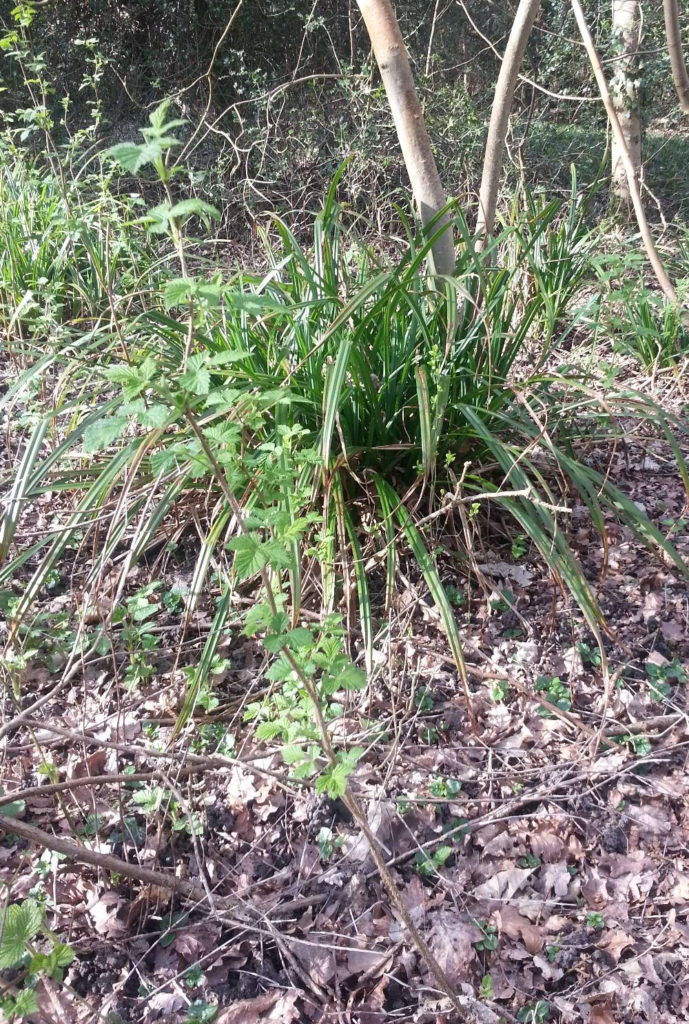
Long trail post 8: Eight paces beyond the path junction the path crosses a low bank. On the left notice the straight stems of wild raspberry; the shoots have thorns but these are thinner and softer than those on bramble. Among the raspberry grows tufts of pendulous sedge; in summer look for the drooping flower spikes.
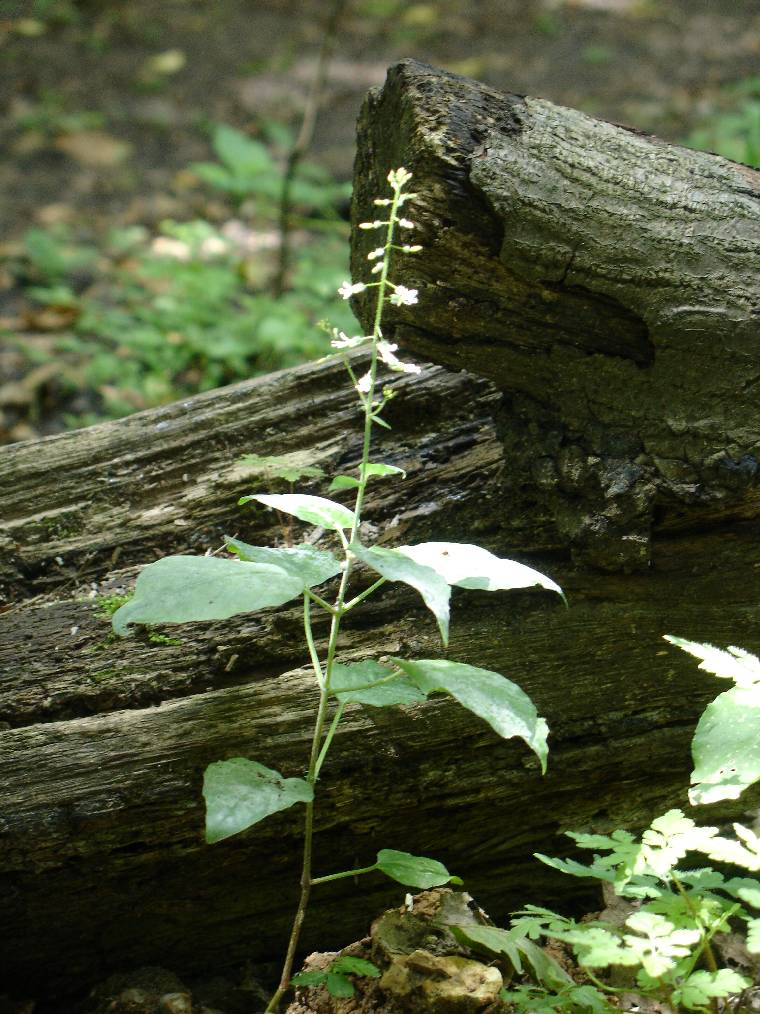
To the right of the path look for bluebells Hyacinthoides non-scripta as well as enchanter’s nightshade Circaea lutetiana with its spike of tiny delicate flowers (see image below). Bluebell and pendulous sedge are two of sixteen ancient woodland indicator plants found in this area of the Common. This is a puzzle, since the trees are certainly not ancient – most are less than 100 years old. It is likely that an area of ancient woodland was felled – perhaps on the orders of the 1st Duke of Chandos (1674–1744) who is thought to have sold timber from here to the navy. Young trees then grew back, allowing the plants of the woodland floor to survive.
Long trail post 9: A line of yew trees gives a dark, sombre appearance to the wood on the left. The area ahead is more open and there are patches of bluebells.To the right of the path is an old tractor tyre – it has been here as long as any of the volunteers who maintain the site can remember!
Twenty paces ahead notice a dead tree that has fallen away from the path, with its base close to the path on the right. We know what killed this tree: look carefully and you can see a network of what look like black bootlaces. These are the mycelium of honey fungus Armillaria, one of the few fungi that attacks and kills living trees.
Long trail post 10: Ahead is the open space of New Heath. While you are still hidden, check the tops of the pine trees on the other side of the Heath: both buzzard Buteo buteo and red kite Milvus milvus like to perch here and watch for mice and voles in the open ground.
Like much of Stanmore Common, 150 years ago New Heath was open acid grassland and heathland maintained by grazing, but when grazing stopped birch trees invaded. However around the year 2000 a fire killed many of the birch trees. This was recognised as an opportunity to restore the lowland acid heathland, which is a rare and declining habitat; Hounslow Heath, 20 km to the southwest, is the best example north of the Thames. In the winter of 2007/8, supported by a National Lottery grant, the leaf litter and topsoil was scraped off by bulldozer to reveal the gravel and rounded pebbles of the Stanmore Beds. The next spring we sowed heather (Calluna vulgaris) seed from Hounslow Heath. Among the heather are plants that germinated naturally from the bank of seeds that had lain dormant for over 100 years. The heather is still young but already gives a lovely display of purple flowers in late summer.
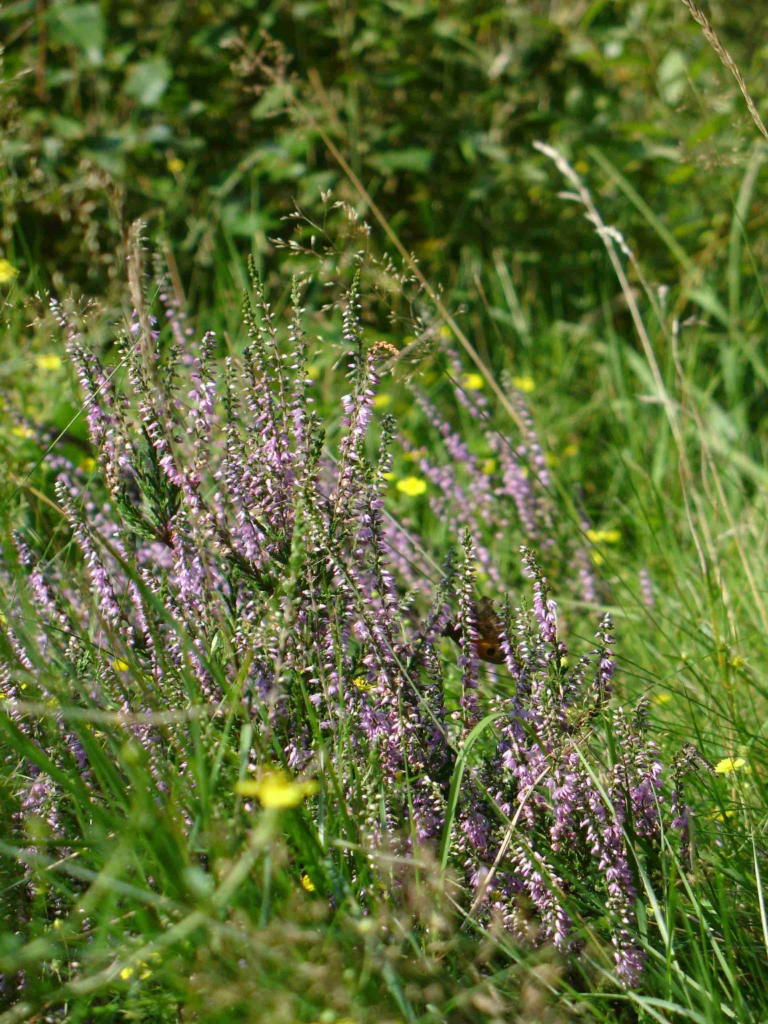
Walk ahead through New Heath to return trail post 1. As you go notice the very yellow tussocks of a rare grass called mat-grass Nardus stricta which is only found in nutrient poor acidic soils. If you look closely at this grass you will notice that the flower spikelets come from only one side of the stem.
The bright green spear like tussocky grass with purple flowers or florets held close to the stalk is purple moor grass Molinia coerulea. This is another plant of acid soil. It is aggressive and can outcompete other grasses.
In summer New Heath is home to masses of grasshoppers and crickets. In summer you will see dragonflies and damselflies who were born in the waters of Pynding Mersc further along the trail.
If you look at the path you can clearly see the embedded rounded stones of the Stanmore Beds. You may also see the holes of solitary bees and wasps that have made nests in the hard packed surface.
More on some of the birds you are likely to see or hear on the Common
More on the three species of deer on the Common and their tracks